


Kelluwün-Medicine Cinema: The Indigenous Circular Gaze | Activity
In his cinematic work, Francisco Huichaqueo —Mapuche filmmaker, activist, and teacher— alters time and rational-discursive narrative to make way for what he calls the temporality of visions, thus opening up other spaces of knowledge and existence: kelluwün (mutual collaboration). This spiral temporality allows for the intertwining of spirit, body, and the pulsation of the earth, revealing the diversity of worlds we inhabit.
Huichaqueo’s work focuses on the decolonization of museums through the reactivation and reappropriation of collections plundered during the colonial era in South America. Questioning academic imposition and its archaeological collections, Huichaqueo proposes a museography of community and spiritual reconnectiondismantling the canon established by contemporary art and its museums, which continue to keep countless memory objects belonging to First Nation and Indigenous communities kidnapped in their vaults.
In opposition to the official history of the victors, his work builds counternarratives. Through cinema, I present the life of the Mapuche community and its connection to biodiversity from an internal gaze and feeling, conceiving Indigenous cinema as an antidote to the colonial wound and as a device that activates other planes of existence. He calls this “medicine cinema,” understood as a filmic breath, similar to the healer’s gesture of blowing a remedy onto a body.
Francisco Huichaqueo calls us to be in kelluwünwhich begins by breaking with narrative linearity and bringing together —even if only temporarily— the confined spirits with their communities, through the circularity of Indigenous time.
participant
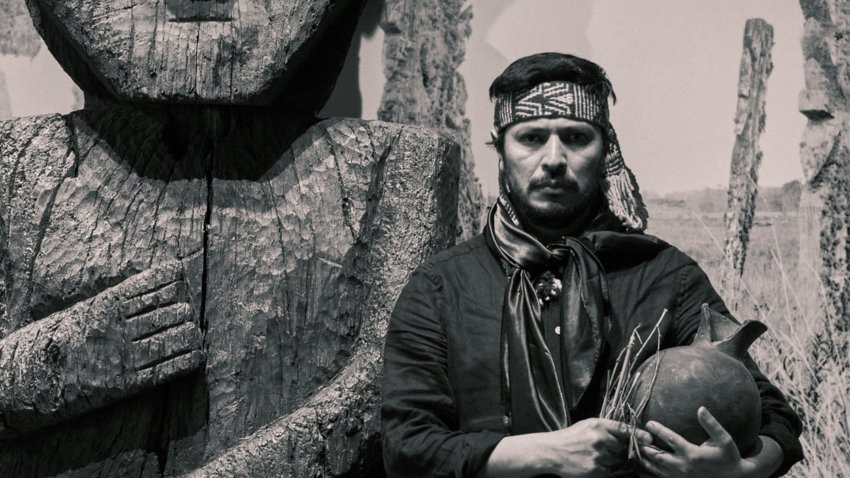
Francisco Huichaqueo is a Mapuche filmmaker, activist, and teacher whose work focuses on the decolonization of museums through the reactivation and reappropriation of collections plundered during the colonial era in South America. His work builds counternarratives to the official history of the victors. Through cinema, he represents the life of the Mapuche community and its connection to biodiversity from an internal gaze and feeling, conceiving Indigenous cinema as an antidote to the colonial wound and as a device that activates other planes of existence. He calls this “medicine cinema”, understood as a filmic breath, similar to the healer’s gesture of blowing a remedy onto a body. His work has been published in international journals and has been exhibited at institutions such as MoMA, the Museo Nacional Centro de Arte Reina Sofía, the Wadsworth Atheneum, MAVI, and the Museo Precolombino in Santiago, Chile. His cinematic work has been presented at multiple festivals, including Toulouse and Mother Tongue (Washington, DC). In 2025, I received the Premio Municipal de Arte from the city of Concepción and was a visiting artist and professor at the University of Connecticut, in the Collective Healings project. He is a professor at the University of Concepción.
read more
Funded by the European Union. Views and opinions expressed are however those of the author(s) only and do not necessarily reflect those of the European Union or the European Education and Culture Executive Agency (EACEA). Neither the European Union nor EACEA can be held responsible for them.