



The energy transition needs planning, democracy and territorial roots
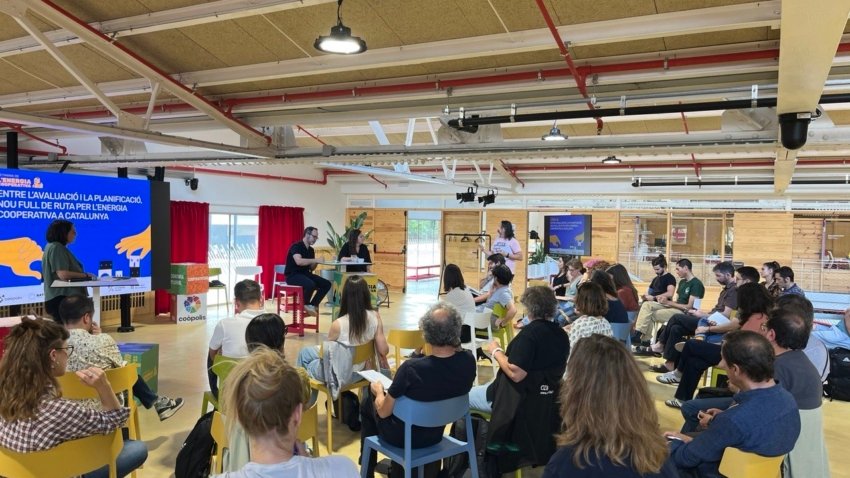
The Friday session of Cooperative Energy Week gathered representatives of the Network for Energy Sovereignty, IDRApublic administrations, cooperatives and energy communities to discuss the challenges of the energy transition in Catalonia and the role that cooperative and community alliances can play.
The first table started from the presentation of the report What energy will we need in 2050 in Catalonia?driven by the Network for Energy Sovereignty. The study argues that the energy transition is not optional and that it is necessary to start implementing it now with a long-term view. The proposal is based on three principles: sufficiency, efficiency and renewable energies, and suggests that in order to guarantee decent living conditions within the planetary limits, it will be necessary to reduce the final energy consumption by at least 45% compared to 2019.
During the presentation it was also insisted that the energy model is not just a technical issue, but a deeply political one. Aspects such as the location of infrastructure, storage mechanisms or territorial distribution are part of a debate that requires democratic participation and criteria of territorial equity.
The second intervention, by Rubén Martínez (IDRA), focused on the ownership and control of energy infrastructures. Based on a parallel with the housing market, he warned that the energy transition could reproduce inequalities if the social and democratic control of energy assets is not guaranteed. In this sense, he defended public-community and cooperative models that allow the distribution of decision-making capacity and the benefits derived from energy generation.
The subsequent debate, with the participation ofARKthe Federation of Agricultural Cooperatives of Catalonia, the AMEP i aquasolhighlighted the need to strengthen the role of municipalities in energy planning, improve public communication on the energy transition and strengthen the tools that allow the deployment of energy projects with citizen participation.
The second table of the day addressed the specific challenges of the energy transition in rural environments. The interventions agreed to point out that energy communities continue to be a tool with great potential, but not yet consolidated. Currently, many initiatives are faced with governance difficulties, a lack of technical and legal resources, and the need to build a solid social base before promoting specific projects.
The importance of agricultural cooperatives, local administrations and social economy entities was also highlighted as key agents to promote an energy transition rooted in the territory. Participants agreed that it is necessary to move towards models that not only generate renewable energy, but also guarantee social return, democratic participation and shared benefits for local communities. Territorial alliances that seek the same objectives, that go beyond shared self-consumption initiatives and are reflected in a return to the territory, understanding its complexities and needs.
The day concluded with a shared idea: the energy transition cannot be measured only in megawatts installed or speed of deployment. It is also necessary to ask who decides, who controls the infrastructures and who benefits from the new energy model. For this reason, cooperatives, energy communities and public-community alliances appear as essential tools to build a fair and democratic energy transition.