


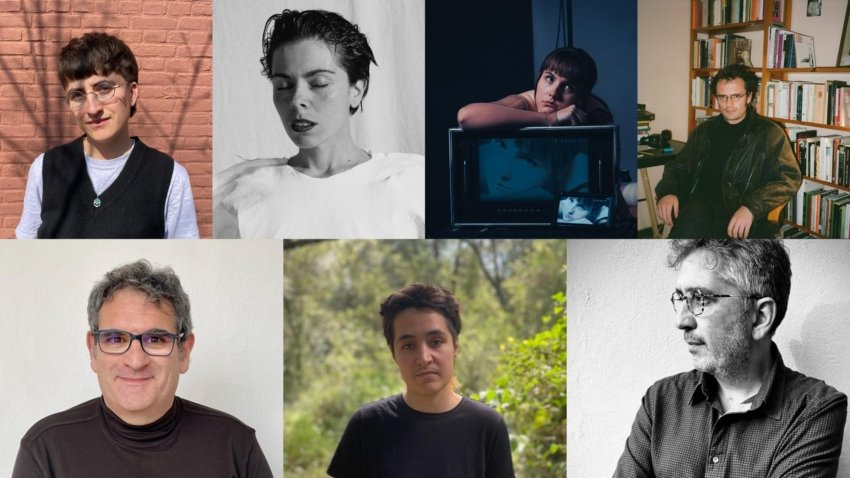
The international residency centers partnered with the Institut Ramon Llull have announced their selections for the 2026 stays following an open call. For writing residencies, Art Omi in the United States has selected Manuel Baixauli and Alba Walnut Tree for stays from 24 September to 15 October and from 21 October to 18 November, respectively.
Meanwhile, Château de Lavigny in Switzerland will host Jordi Puntí from 28 July to 24 August. Finally, Literarisches Colloquium Berlin in Germany you have selected Julia Sentís for a residency from 1 to 31 August, and Eduard Olesti for a residency from 1 to 30 November.
In the performing arts, the Transmission Impossible residency, part of the Festival of Avignon program, will welcome Antonia Roiga drama student at ERAM, from 2 to 16 July. At Marriage in Italy, Anna Ferrer will be in residence from 15 to 25 October.
The Institut Ramon Llull’s strategic residency program is designed to promote the participation of Catalan and Balearic creators at prestigious international residency centers, particularly those offering significant opportunities for visibility, networking and creative development.
Manuel Baixauli (Swedish, 1963) is a painter and writer. spiral (Columna, 1998), his first published book, is a collection of short stories. I followed this up with the novels Verso (Bromera, 2001) and The Manuscript Man (2007), which won six awards. In 2014 I published The fifth floor (Proa), a novel that received the Premi de la Crítica dels Escriptors Valencians and the Premi Crexells de Narrativa Catalana. In Nobody is waiting for us (Periscopi, 2016), I present a collection of diary-like articles accompanied by his own drawings. With unknown (Periscopi, 2020), he won the 2020 Premi Llibreter for best Catalan literature book. His latest book, Horse, athlete, bird (Periscopi, September 2024), was awarded the 2024 Premi Òmnium for best novel of the year.
Dawn Walnut (he/they) (Palma, 1997) is a philosopher and writer. Their first novel, monument (Adia Edicions), was awarded the 2025 Premi Antoni Vidal Ferrando de Narrativa. They were a finalist for the 2025 Salvador Iborra Poetry Prize and have published stories in Morlanda magazine. They currently serve on the editorial board of solstice magazine and work in cultural management.
Jordi Puntí (Manlleu, 1967) is a fiction writer and regular newspaper columnist. He has published three collections of short stories. His first novel, Lost bags (2010), won numerous awards and has been translated into 16 languages. He is also the author of The Castiliansa work of autobiographical fiction, and Everything Messi. In 2023 I published confettia novel that explores the boundaries of biography and fiction, which won him the prestigious Premi Sant Jordi.
Eduard Olesti (Barcelona, 1995) is a writer and theater director. He has published the novel standing dogs and the poetry collections A twilight cowboy and Sarcop. As a director and playwright, I have worked on productions such as Acute Renal Failure (Beckett Room), Barcelona Ratafia (Parallel 62), CAÍN loops and did it again (Old Greek Theater 2024), and Shrek, kebabs and the Fall of Yugoslavia (TNT). He has also worked as a curator, screenwriter, translator, spoken word artist and performer.
Julia Sentís (Barcelona, 1995) researches the intersection between poetry, the moving body, fabulative practices, pedagogy and mediation. She holds an undergraduate degree in Humanities (UPF) and a Master’s in Artistic Practices and Cultural Studies: Body, Affects, Territory (UPV, UPNA, Centro Huarte). She has trained in movement research practices through somatics, biomechanics and improvisation. She works as a teacher and also pursues artistic research. Her first poetry collection, palpable (2026), won the 2025 Salvador Iborra Young Art Poetry Competition.
Antonia Roig (Mallorca) is a fourth-year student of Performing Arts at Escola Universitària ERAM (Girona). She began her artistic training in choral singing and viola at the Escolania de Lluc (2013-2020). Her work focuses on text-based theater from an acting perspective. She is currently working on an original piece with Anna Mateo for her final degree project. The conceptual core of the work is the transformation of the self through the gaze of the other. She also explores the role of the spectator as an active participant in the theatrical event, with the performers shifting between character and actress.
Anna Ferrer (Menorca, 1993) sings, composes and deconstructs songs from the past. She preserves and reworks traditional folk song, demystifying it and making it universal. In this way, her music draws inspiration from tradition while evolving into her own unique soundscapes, infused with synthesizers. Anna Ferrer’s current offering is PAa performative concert that emerged from the need to ritualize the intergenerational transmission of a family craft. Ferrer takes the stage accompanied by her father, two musicians and a repertoire that blends orality, popular imagery, research and artistic experimentation.