



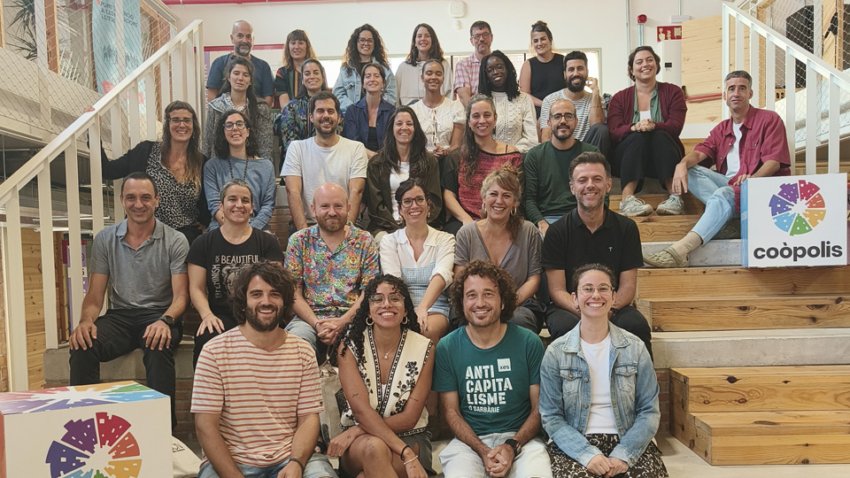
Coòpolis promotes a leap of scale of the ESS
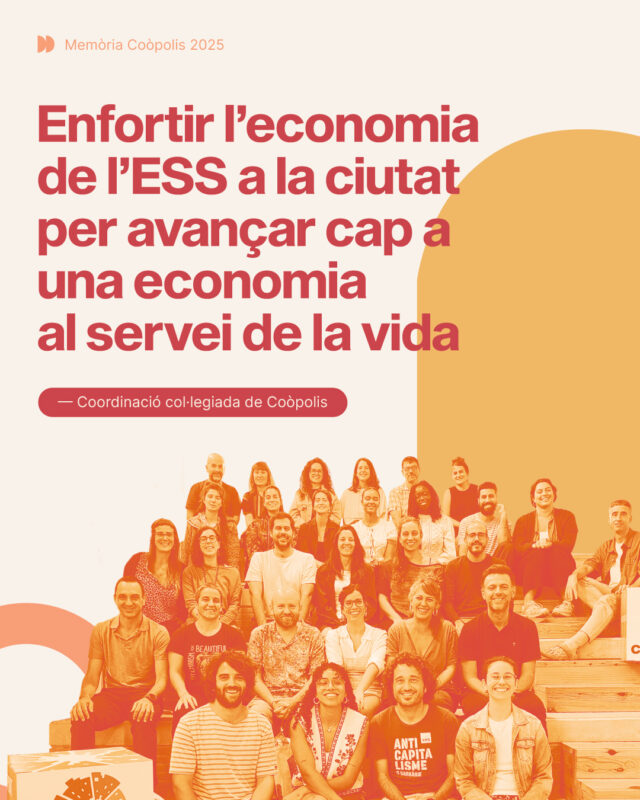
Coòpolis consolidates its role as a key infrastructure of the city of Barcelona to strengthen the Social and Solidarity Economy (ESS), in a context marked by the ecosocial crisis, precariousness and the increase in exclusionary discourses. The Report 2025 reflects a year of strategic maturationwith the aim of making the ESS a central proposal for an economy at the service of life.
Far from focusing only on growth, 2025 has been a year to weave links, strengthen relationships and give more density to co-operatives, consolidating the ESS as an economic infrastructure with the capacity to have a real impact on the city.
In the framework of the Ecosocial Transition, Coòpolis has strengthened its capacity for analysis and strategic orientation. Through the Observatory area, it has combined diagnosis, applied research and knowledge rooted in the territory to read the challenges in more depth. From this work has emerged the Strategic Plan 2024–2027a shared roadmap that seeks to align efforts and give collective meaning to everything that is done.
The plan sets four main objectives: to expand and diversify the ESS, to consolidate its structures, to promote the eco-social transition and to generalize its access, especially among historically excluded groups. These axes are complemented with transverse lines such as feminist economics, anti-racism, the right to housing and energy, and food sovereignty. The main challenge is now to transfer this strategic framework into practice, especially through the deployment of Bloc4BCN, with the aim of democratizing the economy in all the neighborhoods of the city.
From impulse to consolidation: strengthening existing cooperativism
2025 has confirmed a paradigm shift: the challenge is no longer just to create new cooperatives, but guarantee the sustainability of the existing ones. Coòpolis has accompanied 179 projects and has significantly increased the hours of advice, with consolidation as the main focus of intervention.
This commitment responds to a clear reality: the growth of cooperatives cannot depend only on new initiatives, but on their ability to resist, grow and articulate. The Bloc4BCN has established itself as a key infrastructure in this process, offering a shared environment of incubation, training and inter-cooperation that facilitates the maturation of projects.
One of the great learnings is that inter-cooperation must go from being punctual to structural. Coòpolis bets on building virtuous circles of ESSconnecting production, consumption, services and financing within the same cooperative economic circuit.
This approach involves developing complete value chains in strategic sectors and encouraging the pooling of resources, from energy and food to care and mobility. The aim is to move towards an economy that is more autonomous, rooted and able to respond to everyday needs.
Territorializing the ESS: beyond central spaces
Territorialization is key to expanding the impact of SSE. During 2025, work has been done to extend the activity to new districts and strengthen local networks, especially in neighborhoods with great cooperative potential such as Sant Martí, Nou Barris or Sant Andreu.
This process involves not only decentralizing activities, but redistribute resources and infrastructurestrengthening local ecosystems and generating economic and community capacity from the proximity. Local networks and urban communities become key actors in this articulation.
Education, training and cooperative culture
The training has been consolidated as a strategic tool for the dissemination and strengthening of cooperativism. The training offer has combined awareness, creation itineraries and consolidation programs, with a clear commitment to shared knowledge between cooperatives.
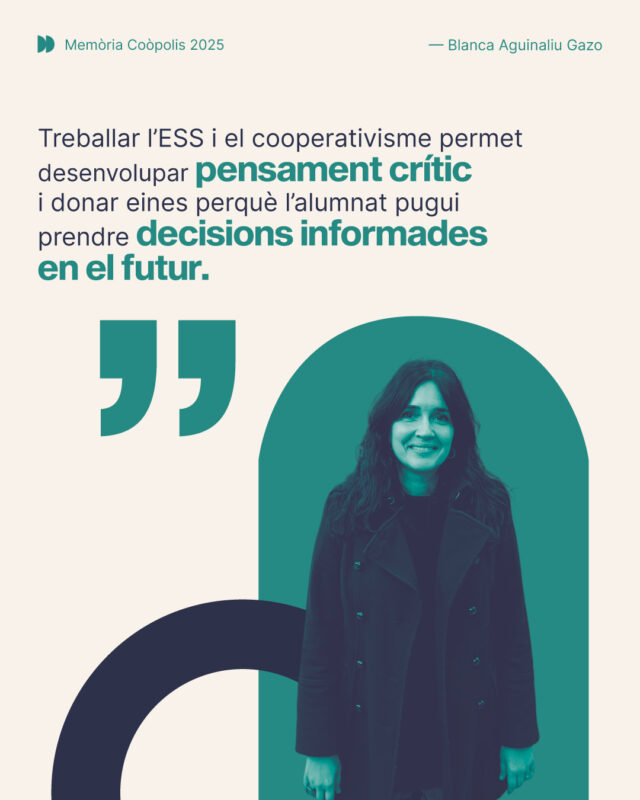
In classrooms, especially in vocational training, cooperativism has established itself as a real alternative that encourages critical thinking, participation and the construction of meaningful collective projects.
Diversity, feminisms and migrant economies
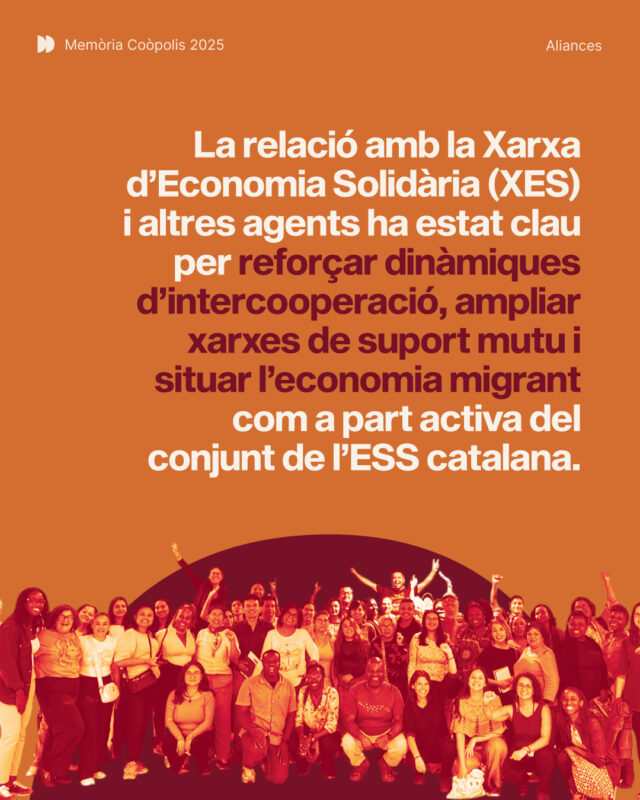
The report highlights the central role of feminist and migrant economies in the transformation of SSE. The annual meeting of ESS Migrant and Diversa, with more than 100 projects, exemplifies the growth of an economic fabric that gains organizational capacity and influence.
At the same time, feminist cooperativism claims the need to decommoditize care and build public-community models that guarantee rights and dignify work, connecting this debate with cooperative housing as a life infrastructure.
Ecosocial transition and new strategic sectors
Faced with the ecosocial crisis, Coòpolis promotes programs like Cooperatives in Transitionwhich accompany entities in sustainable transformation processes adapted to their reality.
At the same time, the need to gain a presence in key sectors such as logistics, mobility or local trade is identified, as well as progress in reindustrialisation and production. This sectoral leap is essential to expand the incidence of cooperatives in the real economy.
Within the framework of the right tohousing and the energy transitionCoòpolis has continued to promote an integrated look between energy and housing as key parts of a just Ecosocial Transition in the city. Through the Network of Energy Communities of Barcelona – promoted jointly with the FAVB – a stable space for the articulation of energy sovereignty projects rooted in the neighborhoods has been consolidated, which today already connects a dozen driving groups in different phases of development. This work has made it possible to move from isolated initiatives to a collective dialogue with the administrations, strengthening the role of the energy communities as recognized agents of the Social and Solidarity Economy. At the same time, the link with experiences of cooperative housing in transfer of use has highlighted the potential of these models when they are connected: energy and housing cease to be separate areas to become a community infrastructure of life, where self-management, co-responsibility and the right to live with dignity are worked together. From this perspective, initiatives such as the Resource Communities and the dissemination, training and advocacy actions deployed around energy sovereignty and housing reinforce the same basic idea: that the transformation of the urban model involves building communities capable of collectively managing what is essential for living.
Looking Ahead: Consolidate, Connect and Scale
Looking ahead to the coming years, the challenge is not to grow in a disorderly manner, but consolidate a coherent and scalable model able to generate structural impact. This implies strengthening economic viability, diversifying funding, improving governance and deepening inter-cooperation.
In a context of global transformation, Coòpolis claims the ESS as one essential tool to build a fairer, more democratic and resilient citycapable of putting life at the center and generating real alternatives to the dominant economic model.
you can consult the 2025 Report here!