


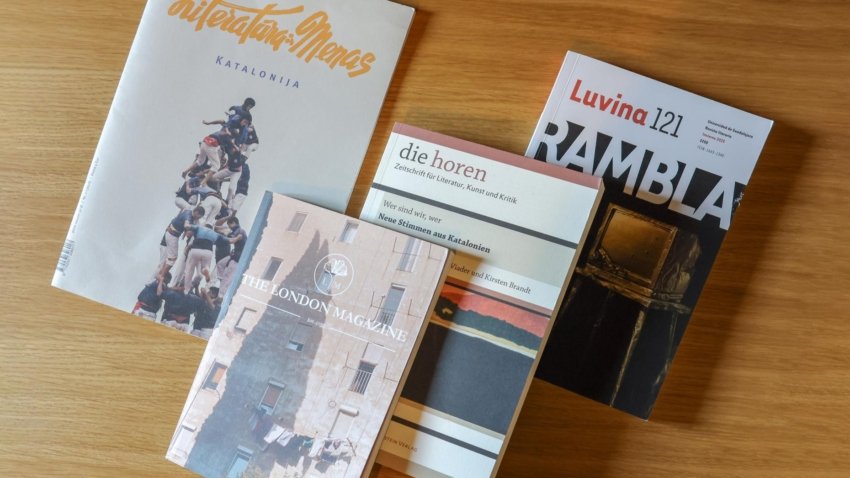
Four prestigious international literary journals have focused on Catalan literature in recent months: The London Magazine in the UK, Literature ir Menas in Lithuania, Luvina in Mexico, and Die Horen in Germany. This presence makes it possible to reach both new audiences and specialized readers worldwide, while fostering recognition within critical and academic circles. Furthermore, it highlights both the quality of the authors and the key role of translators, who are indispensable in bringing these works to an international audience. Around a hundred writers have featured in these leading publications, which have received support from the Ramon Llull Institute (IRL).
The London Magazine
This is England’s oldest literary periodical, with a history stretching back to 1732. Today it is a key point of reference in the British literary landscape. Its pages have featured works by writers ranging from Percy Bysshe Shelley, William Hazlitt and John Keats in the 19th century, to TS Eliot, WH Auden and Evelyn Waugh in the early 20th century. The publication, which brings together ideas and voices from around the world, is published six times a year.
The 22 Catalan authors featured are: Eva Baltasar, Mireia Calafell, Míriam Cano, Mari Chordà, Carles Dachs, Marina Garcés, Raül Garrigasait, Gemma Gorga, Pol Guasch, Laia Llobera, Anna Montero, Quim Monzó, Sergi Pàmies, Carla Pérez Vas, Oriol Ponsatí-Murlà, Irene Pujadas, Àngels Ribé, Rowan Ricardo Phillips, Mercè Rodoreda, Irene Royo Casadó, Adrià Targa and Antònia Vicens.
Literature ir Menas
This cultural publication dedicated to literature and art first appeared on 21 July 1946 in Vilnius (now the capital of Lithuania) as a weekly magazine of the Soviet Writers’ Union of the Lithuanian SSR and the Council for Artistic Affairs. Following political changes, its focus evolved, and it has been known as the biweekly magazine of the Lithuanian Writers’ Union since 1989. The magazine combines articles on cultural events, literature, music, visual arts, theater, film, architecture and cultural heritage with original and translated works of fiction. Its February issue included pieces about 13 Catalan authors: Raül Garrigasait, Elvira Prado-Fabregat, Joana Torruella, Enric Gomà, Gerard Furest i Dalmau, Maria Cucurull Canyelles, Oriol Puig Taulé, Neus Penalba, Xavier Pla, Noelia Ramírez, Clàudia Rius i Llorens, Eva Baltasar and Adrià Targa.
Luvina
To mark Barcelona’s role as Guest of Honor at the Guadalajara International Book Fair, the Universidad de Guadalajara’s literary journal, Luvinapublished a special feature in its winter 2025 issue featuring 32 Catalan authors. Luvina has been published continuously for 29 years, establishing itself as one of the most prestigious publications in the Ibero-American world. It is published four times a year and has a print run of 1,300 copies.
The Catalan authors featured are: Mireia Calafell, Xavier Mas Craviotto, Gabriel Planella, Jordi Puntí, Blanca Llum Vidal, Mercè Ibarz, Adrià Targa, Antònia Vicenç, Lluís Calvo, Miquel de Palol, Àngels Marzo, Manuel Baixauli, Bel Olid, Anna Gual, Núria Cadenes, Chantal Poch, Carme Riera, Cèlia Sànchez-Mústich, Susanna Rafart, Xavier Antich, Adrià Pujol Cruells, Mercè Claramunt Diego, Jordi Martí Monllau, Jaume Pont, Julià de Jòdar, Núria Perpinyà, Joan Todó, Irene Pujadas, Antoni Clapés, Ingrid Guardiola, Marta Sagarra and Fer Rivas.
Die Horen
Founded in 1955, this journal on literature, art and criticism is published quarterly. Since 2020, under the editorship of Andreas Erb and Christof Hamann, it has focused on unpublished literature in the genres of prose, poetry and drama. In the final quarter of last year, Die Horen published a special issue dedicated to contemporary Catalan literature. Edited by Oriol Viader and Kirsten Brandit showcased the diverse voices and genres that reflect the vitality of Catalan literary production. Specifically, it featured excerpts from works by: Maria Arimany, Borja Bagunyà, Eva Baltasar, Max Besora, Blai Bonet, Roser Cabré-Verdiell, Mireia Calafell, Alba Dalmau, Juana Dolores, Víctor García Tur, Andrea Genovart, Pol Guasch, Carlota Gurt, Joan-Lluís Lluís, Ángeles Moreno, Jordi Masó, Marta Orriols, Anna Pazos, Josep Pedrals, Albert Pijuan, Irene Pujadas, Raquel Santanera, Martí Sales, Maria Sevilla Paris, Irene Solà and Blanca Llum Vidal.
It also includes illustrations by Enric Garay, Bea Salas and Uncle Guimcreated specifically for this special issue.