



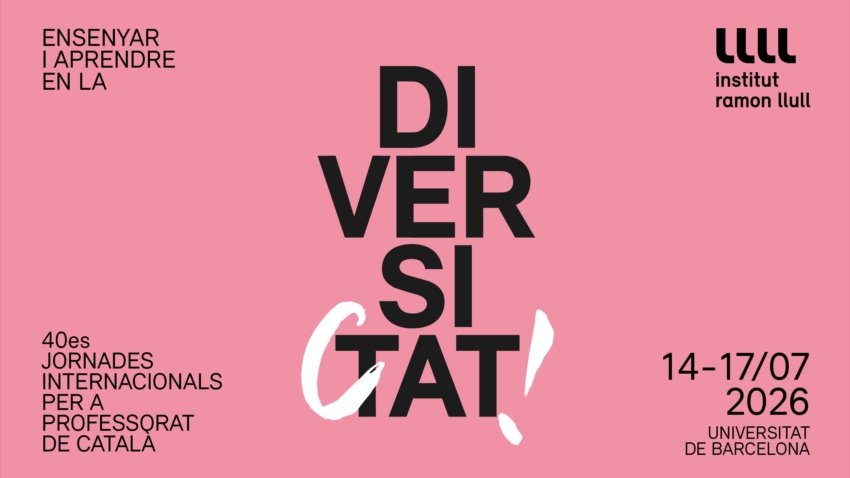
Consolidating and expanding the international community of Catalan studies, extending its geographical presence and promoting academic research are some of the future objectives of the Language and Universities Area of the Ramon Llull Institute, which this year celebrates the 40th International Conference for Catalan Teachers.
From July 14 to 17, 80 Catalan teachers from 25 countries will meet at the University of Barcelona to reflect and debate on teaching activities and strategies for learning Catalan as a foreign language. According to the director of the Ramon Llull Institute, Anna Guitart, “This anniversary recognizes the very important work started in the 80s for the teaching of Catalan in universities outside the linguistic domain. Since assuming this responsibility, in 2002, it has been one of the raison d’être and a priority of the Ramon Llull Institute». Guitart added that “the teaching of Catalan in the universities of the world makes our language and culture present, promotes them and makes them grow. This would not be possible without the work of the professors and their commitment, their appreciation and their dedication, which every year we see renewed with satisfaction and gratitude on the part of the Institute».
The Llull Network, made up of this faculty, is a key instrument for the promotion of the Catalan language and culture and includes 130 universities in 30 countries, of which 93 receive funding from the IRL.
From 2025, the Conferences will incorporate a central theme that allows for an in-depth look at key issues. In this edition they focus on “Teaching and learning in diversity”. During the Conference, specialists of recognized prestige from the universities of the Xarxa Vives will provide reflections and strategies to understand and work in classrooms with situations of functional, sexual and gender diversity, the impact of socio-economic inequalities and the importance of linguistic diversity. according to Josep-Anton Fernandezdirector of the Language and Universities Department of the Ramon Llull Institute, the question of diversity in Catalan classrooms abroad is essential to the teachers’ own task: “We understand diversity as the natural context for teaching Catalan in the world and as a responsibility in the preservation of linguistic diversity”. Attention to diversity implies the objective of guaranteeing inclusive and equitable access to Catalan. According to Fernández, “we want everyone to have access to Catalan, regardless of their socio-economic background, and for the Catalan classroom to be a safe space for everyone, both in terms of functional diversity and sexual and gender identities”.
40 years building an international presence
Various organizations of the Generalitat de Catalunya, such as the Comisión de Lectorados (1980s) and the Department of Universities, Research and Information Society (1990s), gave support to universities outside the linguistic domain where Catalan was taught and articulated the University Network of Catalan Studies Abroad, currently known as Xarxa Llull. This responsibility was assumed by the Ramon Llull Institute when it was created in 2002.
The International Conferences for Catalan Teachers have made possible 40 years of connection between talent, universities and cultures through the Catalan language, and to weave a network between the teaching staff where they can share knowledge and experiences, as well as establish personal and professional links.
During these decades, the Conferences have traveled throughout the Catalan-speaking territory: they have been held in Palma, Andorra, Morella, Perpignan, Girona, Gandia, Vic, Lleida, Castellon, Tarragona y Valenciaamong other cities. Since 2009, the Conferences have taken place in universities in the Live Networkwith which the IRL maintains a fruitful collaborative relationship.
The Llull Network in figures
Data for the 2024-2025 academic year
- 130 universities in 30 countries, of which 93 receive funding from the IRL (2025-2026).
- 4,000 students.
- 160 teachers of Catalan studies.
- Catalan is taught in 4 of the 10 best universities in the world according to the Times Higher Education ranking (Oxford, Cambridge, Stanford and Berkeley) and in 14 of the top 50 universities.
- 3 summer language stays with 90 students from 20 countries.
- 3 professionalization seminars with 50 students from 6 countries.
- 61 cultural activities in 16 countries.
- 6 congresses of international associations of catalanistics.
- Call for doctoral scholarships in Catalan studies (1st edition 2025: 19 applications from 10 countries).
- Degrees in Catalan studies at universities such as Brno (Czech Republic) and Toulouse (France).
Other outstanding data
2025-2026
- 100 years of Catalan studies in Liverpool.
- 50 years in Venice and Rome.
- 20 years in Belgrade and Zadar.
- 10 years of the Catalan Language and Literature degree in Brno (Czech Republic).
- 20 years of the Joan Coromines Chair in Chicago.
2027
- 50 years of the Center for Catalan Studies at the Sorbonne.
- 20 years of Catalan studies in Leeds, Zadar, Massachusetts and Milan.
- 10 years of the Marià Villangómez Chair at the Universität Leipzig.
2028
- 20 years of the Josep Pla Chair at Stanford University.
- 50 years of the North American Catalan Society and the Associazione Italiana di Studi Catalani.
In addition, as the official organization for the evaluation and certification of knowledge of Catalan, the Ramon Llull Institute has awarded 790 certificates in 74 exam locations in 28 countries, with 1,185 people presented.
Catalan, language of the future
The most outstanding recent initiatives and those planned for the 2026-2027 school year are:
- Opening, in September 2026, from Pole of Catalan Studies at the Université de Montréal. It will be the fifth Catalan study center in the world, joining those in London (United Kingdom), Paris (France), Siena (Italy) and Poznan (Poland), and the first outside Europe.
- Start of teaching in Beijing.
- Extension of teaching in Edinburgh.
- Resumption of teaching in Grenoble.
- Next start of teaching at Yale University (United States), Università degli Studi di Udine (Italy) and Universidad Nacional Abierta y Distancia (UNAD, Colombia).
- Consolidation of projects in Toulouse and Salamanca.
- New chair projects with the North American Catalan Society (NACS), the University of California-Berkeley and the Université de Mons.
- Second call for Doctoral Training Scholarships.
- New certification headquarters in Bogotá (Colombia).
- Virtuality: Asynchronous level A1 course with 30 students enrolled.
- Faberllull: Meeting of Catalan Studies Associations (2025) and Meeting of Doctoral Students (2026).
Objectives
The main objective for the next few years is the consolidation of the network and the different publics that make it up.
This implies:
- Build a network of researchers to ensure the continuity of the academic community through doctoral training grants and other research programs.
- Expand the network in three strategic areas: Latin America (Argentina, Colombia, Peru and Brazil), the Arab countries (Morocco and Egypt) and Asia (China, India and Korea).
- Expand the programs for students: increase the places for summer language courses and develop new formats of specialization courses.
- Create network through cultural activities like From Xarxa Llull to the worldthe online activity that is organized annually in collaboration with students and professors of Catalan studies in order to spread Catalan culture throughout the Llull Network and beyond.
You can consult the schedule of the 40th International Conference for Catalan Teachers, which will be held at the University of Barcelona and other spaces in the city, here.