


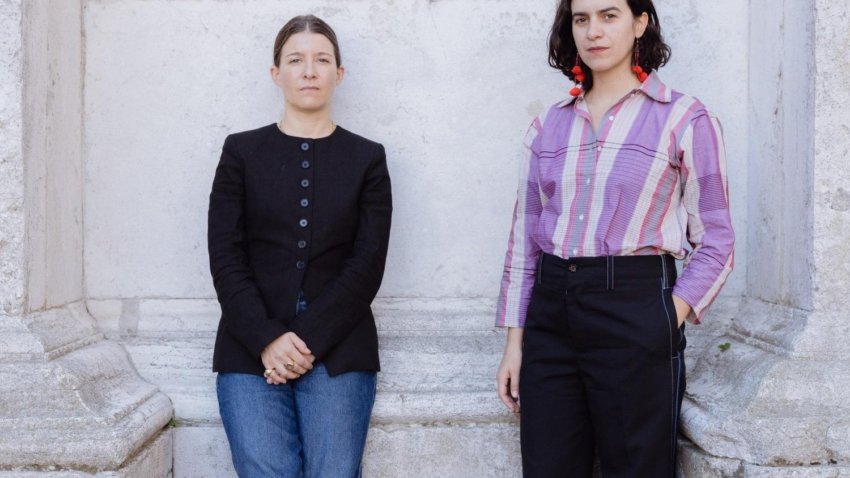
The Ramon Llull Institute presents Catalonia in Venice: Claudia Pagès Rabal, Paper Tears in the 61st International Art Exhibition – La Biennale di Venezia. The installation, curated by Elise Lammer, can be visited from May 9 to November 22 at the Docks Cantieri Cucchini in San Pietro di Castello. The inauguration will take place on May 7 at 18:00 and will feature the interventions of the Minister of Culture, Sònia Hernández, and the director of the Ramon Llull Institute, Anna Guitart.
Paper Tears is an installation by Claudia Pagès Rabal that articulates an investigation into paper watermarks as symbolic and political devices. Through laser projections, a sculptural LED screen and an enveloping soundtrack, these watermarks created in the paper manufacturing process and historically linked to origin and authenticity are revealed and examined. Paper Tears invites us to reflect on how the institutional systems of knowledge and authority have been configured over time, until they collide with the current world.
The watermarks are projected onto the walls of the space Catalonia in Venice and they are activated by a set of heterogeneous characters who comment on them, following intuitive registers rather than institutional rhetoric. The initial watermarks connect us with contemporaneity and mutate in unstable and hybrid forms, while the interpreters move through historical aquifers and strategic water routes in Catalonia.
Paper Tears unfolds through multiple points of view, both in the installation as a whole and in the individuality of each voice and sound, oscillating between the collective narration and the singular experience. Its spatial and conceptual organization is inspired by the underground and surface networks of fresh and salt water – levels, tides and flows – which function as the project’s topological framework.
The archive that constitutes the core of the exhibition is made up of paper filigrees from the 15th century preserved in the archive of Museo Molino Papelero de Capelladesand reflects the artist’s sustained interest in these marks visible only in backlight. Produced at a time when the Mediterranean trade routes declined and the Atlantic trade expanded, they belong to a historical turn often associated with the beginnings of modernity, which gave rise to new regimes of circulation and power. The paper circulated together with ideas, contracts and codes that left evidence of authority, property and regulation. Places like Venice and Catalonia occupied key positions within this transformation, whose logic continues to shape our contemporary condition.
In French, the expression in watermark it refers to something that is under the surface: an idea, an emotion or a tension that resists direct expression but remains present. to experiment Paper Tears it can be like entering a time machine. But not to reconstruct a historical chapter, but because representative elements of a certain time are confronted with contemporary states. In a moment marked by geopolitical conflicts, migratory crises and states of emergency, it reveals a disturbing continuity between the power infrastructures of the past and those of the present.
Claudia Pagès Rabal is a visual artist, performer and writer resident in Barcelona. In his practice, Pagès Rabal mixes words, bodies, music and movement, producing visual and linguistic devices such as video installations, works on paper or books, where points of interest that draw from linguistics, psychoanalysis and decolonizing studies converge. His work has been exhibited in institutions such as Chisenhale, London (2025); Manifesta 15, Barcelona (2024); IVAM, Valencia (2024); Sculpture Center, New York (2024); CA2M, Madrid (2023); Joan Miró Foundation, Barcelona (2023); Tabakalera, Donostia (2022); Vleeshal, Middelburg (2022); MACBA, Barcelona, (2022); Kunstverein Braunschweig, Braunschweig (2021); Sharjah Art Foundation, United Arab Emirates (2018). He will participate in the 18th Istanbul Biennial (2025), and has two upcoming individual exhibitions in mumok, Vienna (2025) and Index, Stockholm (2025). His first novel, More than two waterswas published in Catalan by Empúries Narrativa in 2024.
Elise Lammer (b. Lausanne, Switzerland) is the director of North Hallin Geneva. His practice focuses on the role of space, both public and private, and on the construction and expression of identity. Transdisciplinary in nature, his work adopts a transgenerational and intersectional approach to question and reevaluate narratives that have undergone a monolithic and one-sided integration in history, while examining these issues from a contemporary perspective. As an author, researcher and curator, she has contributed to numerous international projects, such as the Calouste Gulbenkian Museum (Lisbon); mumok – Museum Moderner Kunst Stiftung Ludwig (Vienna); MACRO (Rome); Schinkel Pavilion (Berlin); Center culturel suisse (Paris); MAMCO (Geneva); Kunsthaus Glarus (Glarus); Musée cantonal des Beaux-Arts (Lausanne); Istituto Svizzero di Roma (Rome), among others.
Ramon Llull Institute
As a public institution dedicated to the international promotion of the Catalan language and culture, the Ramon Llull Institute produces and organizes the participation of Catalonia and the Balearic Islands in the Collateral Event of the Venice Biennale. It has been present at the Art Biennial since 2009 and the Architecture Biennial since 2012. The project presented by the Ramon Llull Institute at the Biennial is chosen by a committee of experts that changes every year.