


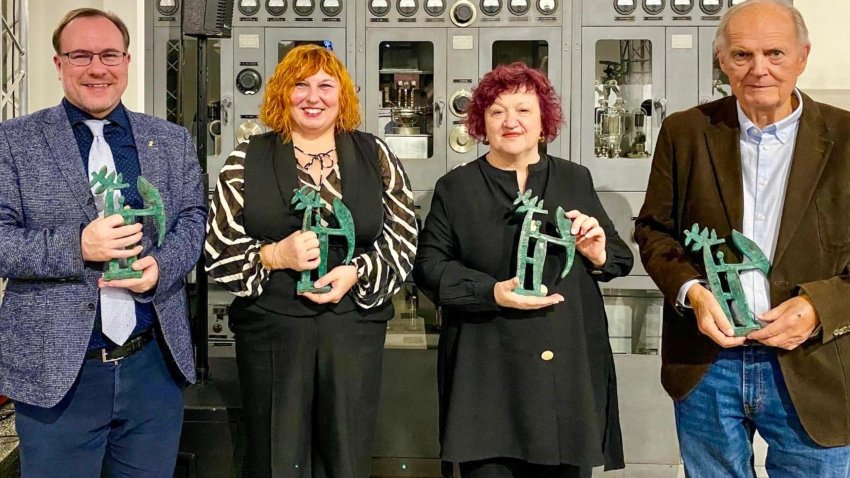
Established in 2008 by the Govern d’Andorra (Government of Andorra) and the Institut Ramon Llull (the Catalan cultural diplomacy body), and later expanded to include institutions from Northern Catalonia, Alghero and the Valencian Community, the mission of the Fundació Ramon Llull is to promote the Catalan language and culture internationally. It oversees compliance with language legislation and promotes projects in collaboration with public and private entities. On Wednesday, it presented the Ramon Llull International Awards in Encamp, Andorra. These prizes are intended to recognize individuals or institutions outside the Catalan linguistic domain that have contributed towards the international promotion of the Catalan language and culture. The winners of this 12th edition are the Roser Bru Foundationtranslator Tiziana Cameraniphilologist Maria Khatziemmanuil and Friulian legal expert William Cicilino. The ceremony was presided over by Xavier Spotthe Head of the Government of Andorra, accompanied by Monica Bonellthe Andorran Minister of Culture, Youth and Sports; Francis Xavier Vilathe Minister for Language Policy of the Generalitat de Catalunya (Government of Catalonia); Teresa ColumbusDirector of the Ramon Llull Foundation; Antonia AndúgarGeneral Manager of the Ramon Llull Institute.
The eighth Ramon Llull Award for the International Promotion of Catalan Creation (Ramon Llull award for the international promotion of Catalan creation) was granted to the Roser Bru Foundation in recognition of his efforts to preserve, research and promote the legacy of Catalan artist Roser Bru i Llop (Barcelona, 1923 – Santiago de Chile, 2021), one of the leading figures in Chilean visual arts.
The panel of judges highlighted its decisive contribution to cataloguing and promoting Bru’s work, notably through initiatives such as the traveling exhibition “Roser Bru de Norte a Sur”, organized as part of her centenary celebrations, and the retrospective “Roser Bru. Superar la distanza” at the Museu d’Art de Girona (2024–2025). The artist, who was exiled to Chile in 1939 aboard the Winnipeg, received over 30 distinctions throughout her career, including the Premio Nacional de Artes Plásticas de Chile (2015) and the Creu de Sant Jordi (2020).
The foundation, created by the artist herself in 2018, holds the largest collection of Bru’s works and archives and promotes projects related to visual arts, memory, gender and history.
Miquel Bofill and Abellóa personal friend of the Bru family, accepted the statuette.
The eighth Ramon Llull Literary Translation Award (Ramon Llull award for literary translation) was presented to Tiziana Camerani for her Italian translation of dead lands by Núria Bendicho, published by Voland in 2024.
The panel of judges mentioned her ability to tackle the work’s complex linguistic challenge while maintaining its tone and diversity of voices. Camerani has been a freelance translator since 1999 and specializes in introducing contemporary Catalan literature, especially by emerging female voices, to Italy. She is also the official Italian translator for the Louvre in Paris.
The Ramon Llull Award for Literary Translation Career (Ramon Llull award for literary translation career) honored Maria Khatziemmanuilone of the main driving forces behind the dissemination of Catalan theater in Greece. A philologist and translator, she has translated over 50 Catalan plays by authors such as Josep Maria Benet and Jornet, Guillem Clua and Sergi Belbel.
Artistic Director of the Festival Iberoamericano de Lectures Dramatizadas since 2012, she has published more than 145 theatrical translations and has been repeatedly honored with the EURODRAM Award. In 2023, she received the Order of Civil Merit of Spain and the AAT Premi Without Borders.
The 34th Ramon Llull International Award for Catalan Studies and Cultural Diversity (Ramon Llull award for Catalan studies and cultural diversity) was granted to Friulian legal expert William CicilinoDirector of the Agjenzie Regjonâl pe Lenghe Furlane (official body dedicated to the protection of the Friulian language, ARLeF). Thanks to the efforts of this agency, which was established in 2006, Friulian has been progressively integrated into schools, the media, public signs and contemporary cultural production, establishing itself as a model of language management for Europe’s other minority languages. Cisilino has held various positions in public institutions dedicated to protecting the Friulian language and identity, and has maintained close ties with projects promoted in Catalan-speaking territories.
This year, the panel of judges highlighted a career that symbolizes the founding spirit of the award: dialogue between cultures, the defense of multilingualism, and the active promotion of minority languages.