



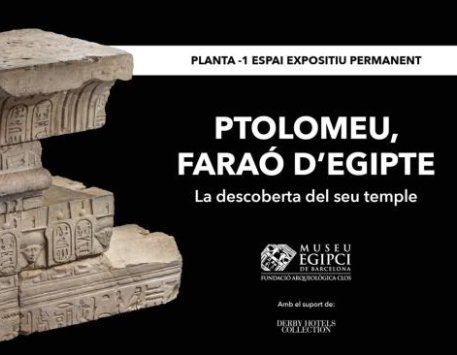
Ptolemy, pharaoh of Egypt
Message of the exhibition: “From 305 BC until 30 BC the throne of the Two Lands of Egypt of the pharaohs was occupied by a dynasty of foreign origin. Ptolemy I, the most successful of the heirs of Alexander the Great, was in charge of establishing what would be solid foundations to guarantee the good development of all areas of society, mainly the economic, the military and the cultural. Egypt, under the Ptolemies, lived three centuries of prosperity as evidenced by the splendor of Alexandria, the intensive exploitation of the Nile valley or the construction of temples dedicated to the gods, both those of the Pharaonic tradition and those of the Greek pantheon. “One of these temples, dedicated to the god Horus and erected in the town of Hut-nesut (currently Sharuna) by Pharaoh Ptolemy I is one of the protagonists of the exhibition. The recent discovery of an important part of its remains has led the Egyptian Museum of Barcelona together with the University of Tübingen and the Supreme Council of Antiquities of Egypt to create a research project whose objective is to enhance the value of this important cult building.” This article of the Cultural Agenda was updated on July 12, 2024, therefore, in anticipation of possible subsequent modifications, we recommend you to compare the information with that published on the website of the Egyptian Museum. You can do so by following the following link: Permanent exhibition “Ptolemy, pharaoh of Egypt” on the website of the Egyptian Museum
Source link