


The European biennial of contemporary art Manifesto 16 will open its doors on June 21, 2026 in the Ruhr Basin in Germany. This new edition of the nomadic biennial will unfold its main activity in the cities of Duisburg, Essen, Bochum and Gelsenkirchen, in one of the most densely populated urban and industrial regions in Europe.
Catalan participation is one of the highlights of this edition. In addition to the central role of the architect and urban planner Joseph Bohigasas curator and member of the artistic team — with the curatorial proposal This is not a church—, Manifesta 16 has four more projects linked to the professional context of Catalan culture, under the artistic programming For Whom the Bell Tolls?: Cabo San Roquewith LOUDER FAIL, Curro Claretwith This is not a church pew, Llorenç Barber and Montserrat Palacioswith How Long in Clapper’s Shadow Fallsi Penique productionswith Möglich Unvorhersehbar (Possibly unpredictable).
This presence, which has the support of the Ramon Llull Institute, consolidates Manifesta’s relationship with Catalan culture, already particularly visible in the previous edition, Manifesta 15, held in the metropolitan area of Barcelona, which programmed more than thirty Catalan artists.
With more than 5.3 million inhabitants, the Rurh basin stands out for its long tradition of converting industrial spaces into prestigious cultural facilities. In this context, Manifesta 16 opts for a new focus of intervention: the so-called Pantoffelnkirchen or neighborhood churches, once central spaces of community life and today, often, disused.
In total, twelve of these buildings—mostly built during the post-war period and with brutalist aesthetics—will host the artistic program. The proposal arises from an investigation led by Joseph Bohigas which proposes to reinterpret these churches not as simple relics, but as incubators of social and cultural renewal in a time marked by digitization and polarization.
This year’s edition will have 107 participants from 31 countries, and can be visited until October 4.
Cabo San Roque they are Laia Torrents Carulla and Roger Aixut Sampietro, resident artists of the Lluís Coromina Foundation since 2015. Their work is developed around sound and its performative capabilities. His interventions question exhibition space and formats; they also question the viewer when inhabiting this physical, temporal and conceptual space; sound and visual Their academic training (music, industrial engineering and architecture) also leads them to use technology in all their works. Since 2012, his works have been exhibited nationally and internationally. In recent years they have been at: CaixaForum + (2023), Center de Cultura Contemporània de Barcelona (2023), Cité de l’Architecture (Paris, 2021), Center Georges Pompidou (Paris, 2020-2021) and Center for Contemporary Arts of Glasgow (2019).
about LOUDER FAILwhich will be installed in Sant Ludgerus (Bochum), explain: “The stadium is activated when it is not scored or scored, when it is not won. In this playing field and decompetitionthe rules and the field are broken and modified by the alteration of its elements, which function as the epicenter that brings together the various conceptual issues of the exhibition. Deformed goals, baskets denormatized and a stage that is also a podium, where the audience in front of the show becomes the subject of competition. They surround themselves with a children’s anthem with fragments of ultra chants that defend their colors to the death“.
Curro Claret, This is not a church pew
Curro Claret studied at the Faculty of Design and Engineering Elisava and Central Saint Martins College of Art and Design. Since the late 1990s he has worked as an independent designer of furniture, objects, artefacts and interiors, focusing his practice on critically rethinking ways of living, making and (re)using existing resources. His practice shows a particular interest in involving groups that, for various reasons, are marginalized, invisible and with few opportunities for participation, exploring forms of empowerment. Their work with these diverse groups is carried out interchangeably with sectoral organisations, such as Arrels Fundació, Tot Raval, Impulsem and We Are Water Foundation; cultural institutions, such as the Centro de Arte 2 de Mayo and La Cuisine Center d’Art et de Design in Nègrepelisse; companies, such as BD Barcelona, Camper and Ziclacities; and academic centers, mainly the Elisava School of Design and Engineering.
about This is not a church pewwhich will take place in San Ludgerous (Bochum) and St. Josef (Gelsenkirchen) explains: “The proposal aims to focus on exploring how the use of furniture can contribute to generating diverse opportunities for meeting. Through a process of dialogue and participation of people linked to the neighborhood, it is planned to design and build a collection of elements that deliberately invite people to meet and interact. The main focus is to transform disused church pews and occasionally other wooden items also sourced from churches. This highlights the use of material and structural resources from what has lost its original function, giving it a new use and a new life in a context that can respond to more urgent needs.”
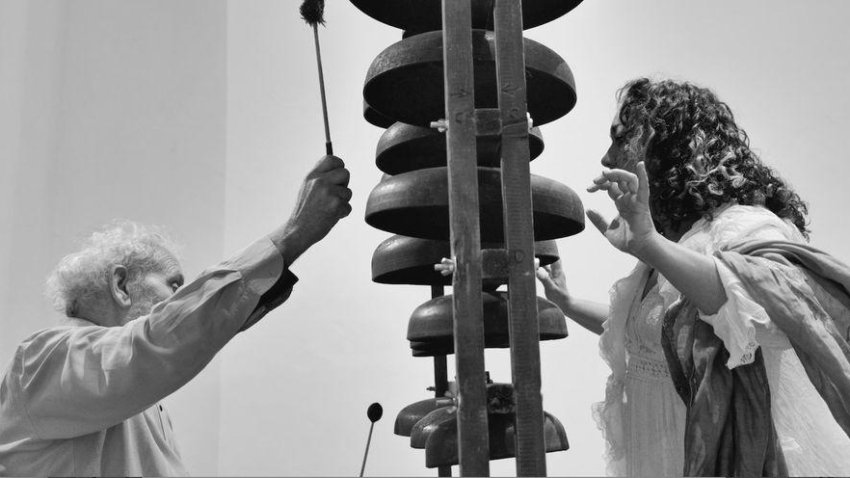
Llorenç Barber and Montserrat Palacios, How Long in Clapper’s Shadow Falls
Bells, everyday objects and voices are the tools with which Lawrence Barber i Montserrat Palacios they explore new musical forms based on the resonances of the environment, giving rise to unique and deeply original proposals.
Llorenç Barber is a composer, instrumentalist and musical activist. He was the creator of the musical action group Actum de València (1973), the Taller de Música Mundana (1978), the Flatus Vocis Trio (1987) and the cycles Ensems (1979), Paralelo Madrid (1992) and Nits d’Aielo i Art (1998). His unique and heterodox creative scope encompasses improvisation, minimalism, multifocal music, phonetic poetry and, in particular, the urban concerts for bells, which he has organized in more than 150 cities around the world.
Montserrat Palacios was born in Mexico, DF. In 2000, she began studying diphonic singing with Llorenç Barber and Thomas Clements. From 1999 to the present, she collaborates with Barber in the ethnomusicological study and the artistic realization of his city concerts with bells, mobile bands and fireworks (aerial percussion), also interested in sound art and the intersection with the visual, plastic and intermediate arts. He currently practices improvisation, vocal performance andextended voicefocusing his work on the use of objects (glasses, teapots, sewing machines, threads, etc.) in relation to the voice.
about How Long in Clapper’s Shadow Fallswhich can be heard in St. Josef (Gelsenkirchen) state: “The sounds of the bells are close, specific, always varied and often insistent. They incite the party, the open air, the street, the collective culmination of the kermesse—“organized for charitable purposes”—something akin to a de-sacralized church mass, now ramified, expanded, a sound that walks and unfolds at every bend or slope. This turns the multifocality in a serpentine, endless fabric of sound – a voracious and gigantic coming and going that reaches everyone. A proposal without limits, which takes on new lives beyond every bridge and every stream. Bell music is, rather, mega-music. His listening is always original“.
Penique productions, with Möglich Unvorhersehbar (Possibly unpredictable)
Penique productions was founded in Barcelona in 2007 by Sergi Arbusà as a project focused on ephemeral installation. Since 2008, Penique also operates from Rio de Janeiro, Brazil. Each project begins by identifying a unique place to build a custom piece: the inflatable. The “balloon”, made of a lightweight plastic, grows and expands as air becomes the supporting structure and forces the inflatable to grow, consuming everything in its path. The space is transformed with a new light, a new texture and a new monochrome color. The viewer is transported through the sensory experience to an environment that is both familiar and new.
about Möglich Unvorhersehbar (Possibly unpredictable)which will take place in St. Josef (Gelsenkirchen), explain: “The work consists of a large white inflatable that occupies the central nave of the church, dialoguing with the architecture of the space. Inside, you can experience the performative nature of the piece, which unifies the space in texture and color, while, outside, the sculptural version of the work reveals its inflatable nature through the protrusions that form between the columns. The central idea is to transform the church into a space for the use and enjoyment of the local population; a space open to the public, open to being lived in the way that everyone understands that it should be lived in and used. A work that disables the church and is generously offered to the local public to own, use and enjoy“.