



10 years ReCooperant Barcelona – Coòpolis
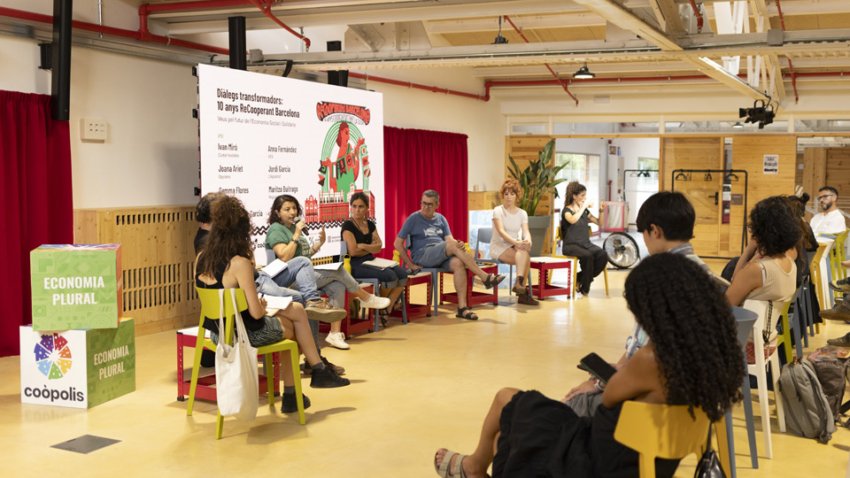
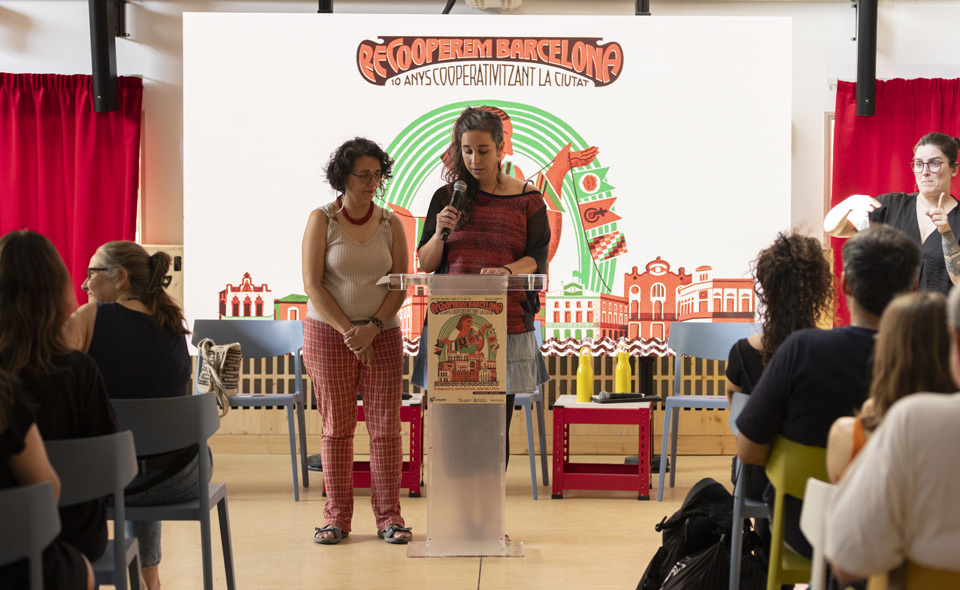
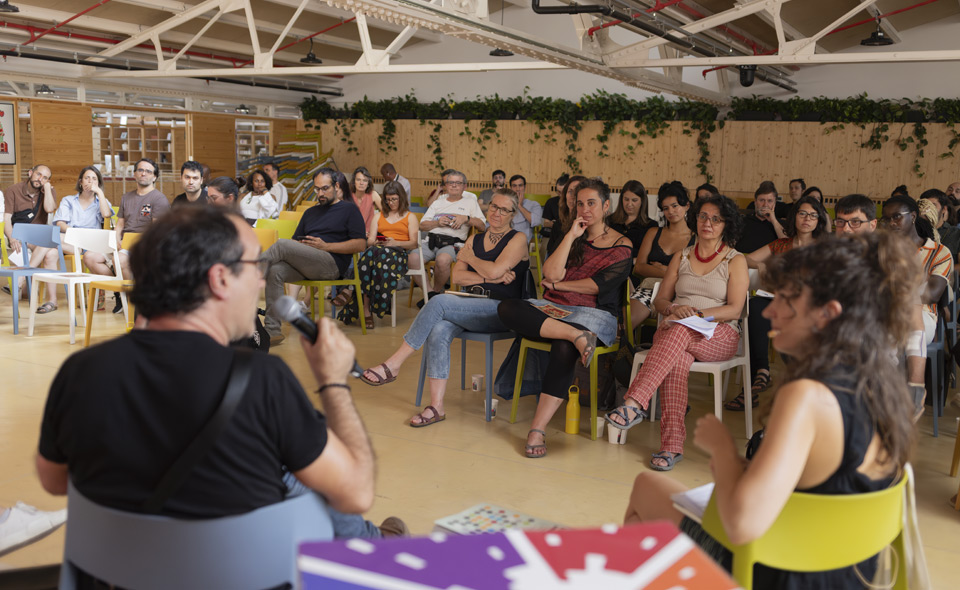
In the framework of the 10 years of Coòpolis, the round table moderated by the journalist Gemma Garcia (The Direct) gathered Ivan Miró (Invisible City), Joana Ariet (options), Gemma Flores (XAC), Jordi Garcia (The Apostrophe) and Maritza Buitrago (Regularization Ya) to reflect on the role of the social and solidarity economy (ESS) in the face of increasing inequalities, the expansion of hate speech and the advancement of the extreme right.
The conversation started from a shared diagnosis: we live in a context marked by the ecosocial crisisthe precarious living conditionsthe difficulties in accessing housing and the strengthening of dynamics of structural racism. Faced with this scenario, the participants agreed to point out that theESS has proven to be one resistance toolcollective organization and the generation of real options as a response to neoliberal capitalism, but which still has significant challenges in expanding its transformative capacity and reaching wider sectors of the popular classes.
The importance of genealogy and balance sheets
Several interventions highlighted the need to remember the collective processes that have made possible the development of the ESS during the last decades. Ivan Miró claimed the importance of building a genealogy that connects experiences such as the crisis of 2008, the 15M, the community struggles of Can Batlló, the deployment of the Solidarity Economy Network or the first public policies to promote cooperativism.
In the same vein, Gemma Flores recalled that today’s consolidated tools such as the Cooperative Ateneus or spaces such as Bloc4BCN are the result of demands driven by the cooperative movement itself and social movements, and that they must be claimed as collective conquests.
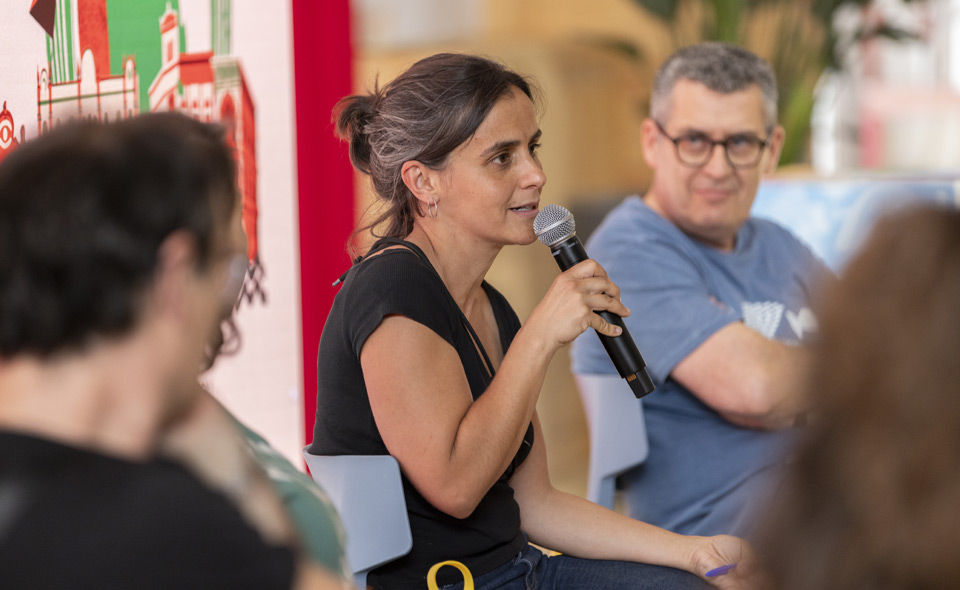
Maritza Buitrago also highlighted the pioneering experiences which have contributed to incorporate the anti-racist perspective into the ESSsuch as Mujeres Pa’lante, MigrESS, Diomcoop or Top Manta, and defended the need to recognize the paths taken in order to face future challenges.
A social economy more rooted in the popular classes
One of the main debates revolved around the capacity of the ESS to reach the people and groups that suffer most from social inequalities.
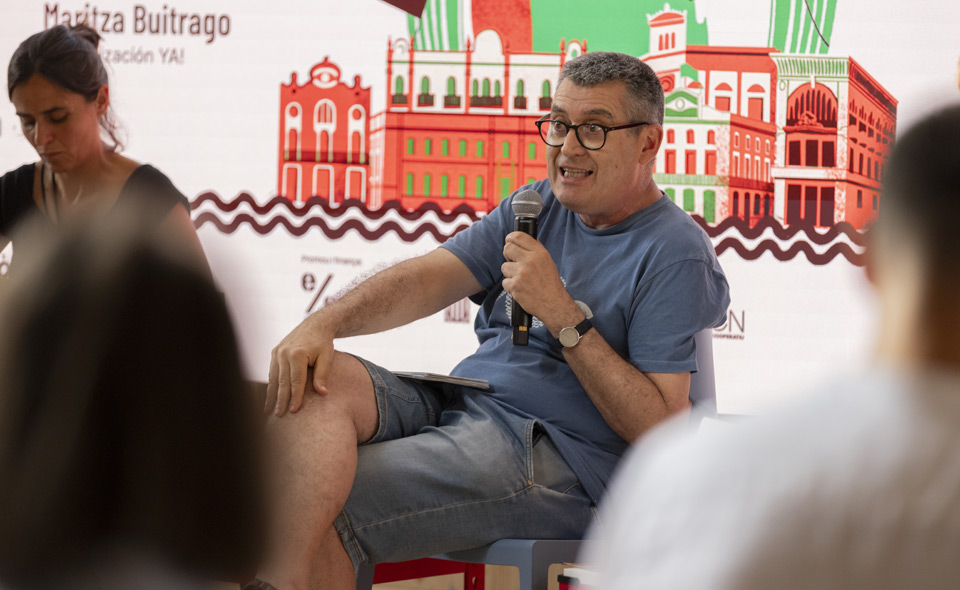
Jordi Garcia pointed out that, despite the progress achieved, the ESS is still in many cases “too white, too university and too linked to certain professional sectors”, and defended the need to incorporate new sectors of the popular classes, as well as reduce the administrative, economic and cultural barriers that hinder access to cooperative projects.
In this sense, the participants agreed to broaden their view of what we mean by social and solidarity economy, incorporating popular economy practices, community initiatives, mutual support networks and projects driven by migrant and racialized people.
Maritza Buitrago emphasized that democratizing resources remains a pending subject and warned of existing inequalities in the distribution of public and private resources within the ESS ecosystem itself.
Disputing the story before the extreme right
The need to confront the rise of hate speech and the extreme right was another of the central issues of the debate. Joana Ariet pointed out that the extreme right connects with the material anxieties and uncertainties of a large part of the population, especially in territories affected by precariousness. Faced with this, he defended that the ESS must be able to better explain its proposals, build comprehensible stories and connect with people’s everyday needs.

Among the priorities indicated were strengthening awareness-raising tasks, gaining a presence in the territories, defending basic rights such as housing, building broad alliances with other social and cultural movements, and stop thinking of yourself only as an alternative to start projecting yourself as a real option for a social majority.
The strategic sectors to sustain life
The debate also addressed what the strategic areas where the ESS should strengthen its presence in the coming years.
the care, housing, food, energy and education they appeared as key sectors to guarantee rights and sustain life. The importance of continuing to promote cooperative projects in these areas was highlighted, but also of providing them with more resources, financing and capacity to scale.
Maritza Buitrago placed the administrative regularization of migrated people as one of the major immediate challenges. He recalled that the process promoted by RegularizaciónYa can allow hundreds of thousands of people to access fundamental rights, and raised the need for the ESS to be able to accompany this new reality by generating decent employment, economic opportunities and support mechanisms.
For his part, Jordi Garcia raised the possibility of expanding the ESS through the cooperative relief of shops, small businesses, workshops, agricultural operations and economic activities rooted in the territory that are currently at risk of disappearing.
Consolidate the built structures
The last part of the conversation focused on the instruments needed to strengthen the ESS in the face of future challenges. The participants agreed on the need to consolidate the structures built in recent years: Cooperative Universities, Urban Communities, shared cooperative spaces, ethical finance and inter-cooperation networks.
The importance of strengthening the public cooperative collaborationadvance in the responsible public procurement and consolidate public policies oriented not only to creation but also to consolidation of existing projects.
In this sense, the role of ethical finance as a strategic tool to guarantee the autonomy of the ESS and the need to generate more collective resources to face the challenges of capitalization, growth and consolidation.
Looking to the next ten years
The table concluded with a shared idea: the ten years of Coòpolis are an opportunity for to recognize the path taken, but above all to imagine the next steps.
Faced with a context of increasing inequalities, an eco-social crisis and the advancement of the extreme right, the participants defended the need to strengthen alliances between cooperativism, social movements and public institutions, expand the social base of the social and solidarity economy and consolidate it as a tool for economic democratization, defense of rights and social transformation.
The shared challenge is that ESS continues to grow without losing community roots nor the transformative will that has characterized its development until today.