


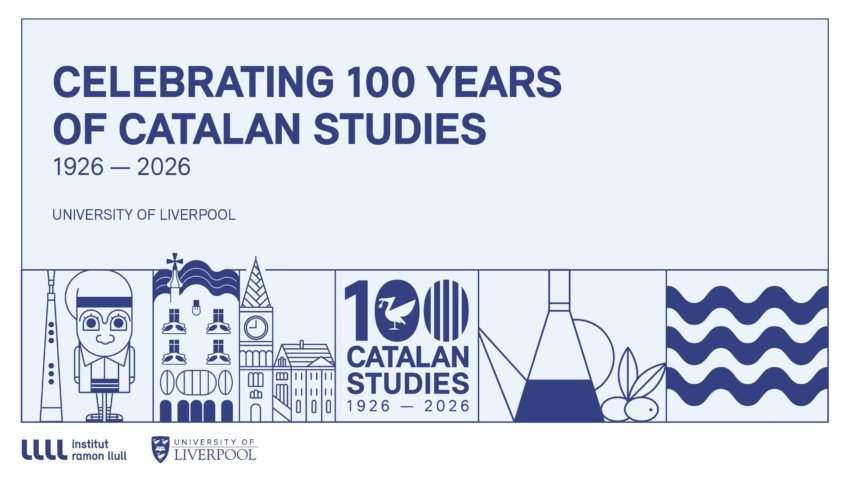
Throughout 2026, the University of Liverpool will celebrate 100 years of Catalan studies in its academic program. It is the UK university with the longest tradition in this field and the first outside Spain to reach this milestone. Its driving force was Edgar Allison Peers (1891–1952), Gilmour Professor of Spanish at Liverpool for 30 years and a pioneer of Spanish and Catalan studies in the UK.
Over the past 100 years, the University of Liverpool has introduced Catalan language and culture to hundreds of students through literature, history, politics, music, gastronomy, architecture, sport and the performing arts. This culture has been presented not only from Catalonia, but also from the other territories where Catalan is spoken as a native language.
To mark this celebration, the university has planned a year-long series of activities that will extend beyond the campus to engage fully with the city, with the aim of bringing Catalan culture not only to students, but also to British society and the Catalan community abroad.
The main events will take place in Liverpool on 10 and 11 March and will consist of a concert by Mataró duo The Tyets and an academic day dedicated to Catalan language and culture, as part of the Annual Peers Symposium organized by the Department of Hispanic Studies since 2009.
The Tyets will give a concert on Tuesday 10 March at legendary venue The Cavern Club, famous for hosting the early performances of Liverpool’s most famous group, The Beatles. Oriol de Ramon and Xavier Coca present one of the most outstanding projects in contemporary Catalan music, blending urban music with distinctive cultural references. Their success has extended beyond the local market and has introduced the Catalan language into spaces where, until recently, it had a very limited presence. Hits such as “Coti x Coti” and the album Epic Solete have established the band as a generational touchstone and a key force in the renewal of the Catalan music scene.
The following day, the Annual Peers Symposium will feature talks on various themes such as the work of Salvador Espriu and the status of Catalan in Northern Catalonia. Writer Charlotte Gurta translator and the 2026 Peers Visiting Writer, will deliver the keynote lecture, in which she will discuss the importance of translation for the international visibility of Catalan literature. The Annual Peers Symposium will be attended by Tim JonesVice-Chancellor of the University of Liverpool. There will also be time for a roundtable session with former lecturers, alumni and current students.
The tradition of Catalan readers at the University of Liverpool began with Ferran Soldevila in the late 1920s and served a dual purpose: to broaden the training of lecturers beyond the restricted Spanish academic sphere of the time, and to contribute to the dissemination of Catalan language and literature in a particularly adverse context. After Soldevila, the position was held by Joan Triadú, Jordi Carbonell, Jordi Rubió and Lois, Ramon Gubern, Joseph Fontana, Enric Lluch, George Nadal, Joaquim Molas, Joaquim Marco, Ramon Sumoy, Xavier Serrahima, Joan Lluís Marfany and Joaquim Nadal.
Since the Institut Ramon Llull (the Catalan cultural diplomacy body) was founded in 2002, the Catalan studies lecturers at this university have been Xavier Barceló, Magdalena Ramon, Carme Rodríguez and Joan Mas. The position is currently held by Paul Masdeu.
The centenary celebrations will feature an extensive program of activities throughout the year, including a Menorcan cooking workshop, forums on Catalan cinema, an academic symposium on poetry, and talks on music. Plans are also under way to establish partnerships with the University of Barcelona’s Faculty of Philology and Communication to develop joint projects.
These events are supported by the Institut Ramon Llull, which promotes Catalan teaching at universities and higher education institutions through the Xarxa Llull, a network comprising some 130 universities worldwide with over 4,000 enrolled students.
The centenary celebrations for Catalan studies in Liverpool have also been supported by the Instituto Cervantes in Manchester, the Spanish Consulate in Manchester, the Spanish Embassy in the UK, and the Delegation of the Generalitat de Catalunya (Government of Catalonia) to the United Kingdom and Ireland.