


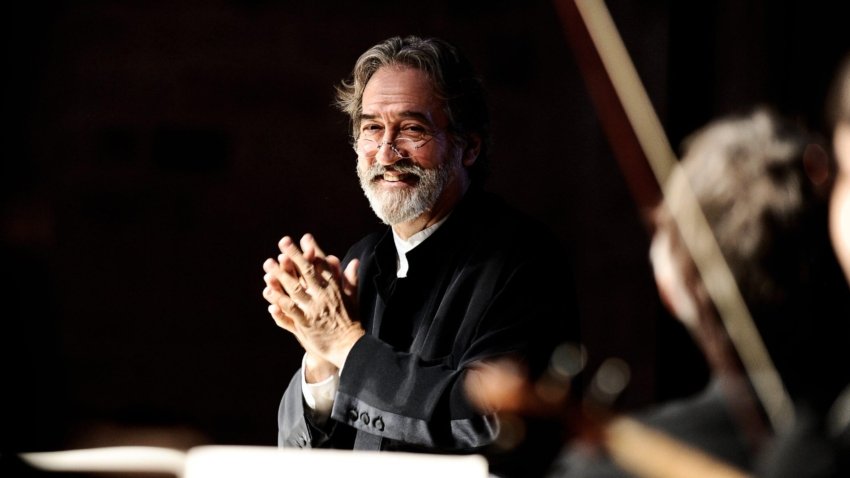
This tribute marks a historical milestone, since it not only marks the debut of Jordi Savall as guest director of the Berlin Philharmonicbut the orchestra is dedicating a monographic cycle to him that combines, over the course of six concerts, his three exceptional facets: viola da gamba soloist, conductor at the head of the Berlin orchestra and mentor of young musicians with the Karajan-Akademie.
The first concert, the November 29will be a recital with Hespèrion XXI. This performance will allow us to appreciate both Savall’s mastery as a solo performer and his deep connection with the repertoire of the Spanish Golden Age and Baroque, with works by Diego Ortiz, Gaspar Sanz, Pedro Guerrero, Francisco Correa de Arauxo and other composers.
Next, the days December 4, 5 and 6Savall will conduct the prestigious Berlin Philharmonic in three consecutive concerts in the Main Hall. In these programs he will apply his interpretative approach – characterized by philological rigor, sensitivity and a deep knowledge of historical practice – to works of Jean-Philippe Rameau, Christoph Willibald Gluck and Wolfgang Amadeus Mozartin an enriching dialogue with the instruments of a modern symphony orchestra.
The January 11, 2026Savall will collaborate with the Karajan-Akademie of the Berlin Philharmonic, an excellent training program for young musicians. The concert, dedicated to works by Jean-Baptiste Lully, Georg Philipp Telemann and George Frideric Handelwill offer students a unique opportunity to work directly with the teacher and incorporate his interpretive criteria.
The tribute will culminate the March 16 with an extraordinary concert in the Main Hall. This evening will be dedicated entirely to Wolfgang Amadeus Mozart and will be performed by Le Concert des Nations, with original instruments, and La Capella Nacional de Catalunya. The program will include the Concerto for clarinet in A major, K. 622con Francesco Spendolini as a soloist, and the sublime Requiem in D minor, K. 626 (in the version of Franz Xaver Suessmayr). It will be a unique occasion to rediscover the beauty and depth of Mozart through the historical interpretation and with the instruments of his time.