


The object poems of Joan Brossa dialogue with the object work of other artists in the new cycle of exhibitions of the Center de les Arts Lliures – Fundació Joan Brossa
- The Liberal Arts Center of the Joan Brossa Foundation inaugurates the series of exhibitions Say what Joan Brossa and the subject poemswhich will be deployed until June 27, 2027.
- The project, curated by Marc Navarro, relates Brossa’s object poems to other artists who work on the artistic construction of objects from poetic parameters.
- The first exhibition presents a total of sixteen works among the pieces by Joan Brossa and international artists Denise A. Aubertin, Henri Chopin, Maria Loboda, Henrik Olesen and Rosemarie Trockel.
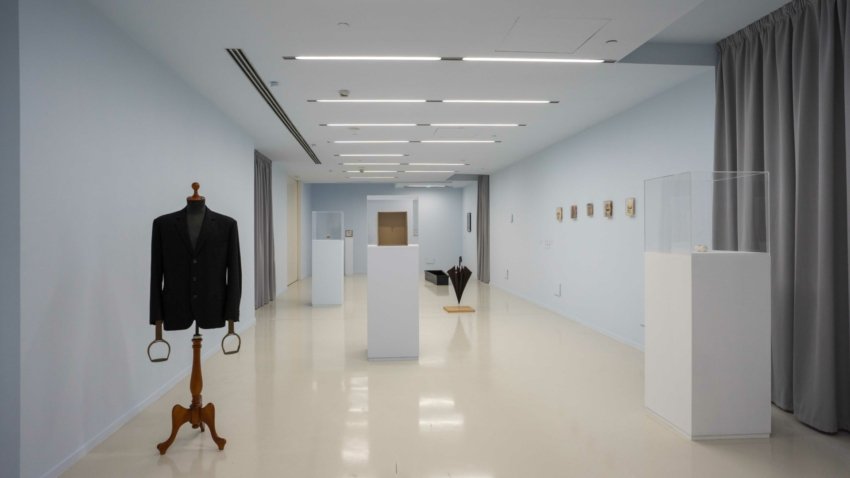
Barcelona, November 4, 2025 – The Liberal Arts Center of the Joan Brossa Foundation inaugurates today, Tuesday November 4 at 6 p.m., a new series of exhibitions entitled Say what Joan Brossa and the subject poems. In care of Marc Navarrothe cycle is the result of a research on the object artistic work and presents a selection of object poems by Joan Brossa to make them dialogue with the work of artists who also work with the object and language, such as Denise A. Aubertin, Henri Chopin, Maria Loboda, Henrik Olesen i Rosemarie Trockel. The cycle will present, until June 27, 2027, new versions of the exhibition that is now being inaugurated.
Cycle of exhibitions
the cycle Say what Joan Brossa and the subject poems present one research in the area of object arts as a stream of artistic creation and thought. In this context, the exhibitions that will take place will present a selection of subject poems by Joan Brossa in dialogue with works by artists who work at the intersection between object and language. With the object poems as protagonists, the cycle aims to present new perspectives on Brossa’s work by putting it in relation to artists who have also approached object artistic creation from poetic parameters, but from diverse temporal, geographical or creative contexts. In this first exhibition, Brossa’s work dialogues with international artists Denise A. Aubertin, Henri Chopin, Maria Loboda, Henrik Olesen i Rosemarie Trockel.
With this series, the Free Arts Center continues to pursue the mission of the Joan Brossa Foundation to preserve, exhibit and disseminate Brossa’s legacy while expanding its readings and universalizing his work and his transgressive spirit. The next of the exhibitions in the cycle will take place during the spring of 2025when new pieces by Joan Brossa and other artists yet to be confirmed will be added to the exhibition hall. The last exhibition of the cycle will end on June 27, 2027.
Poems subject of Joan Brossa
Joan Brossa presented the first “experimental poems” in 1951, with Dau al Set, at the Caralt gallery in Barcelona, the first poems to be the subject of an extensive production that would take place between the sixties and nineties. This one expansion of register would go in parallel with the transformation of his literary poetry and the avant-garde artistic discourses linked to the presence of the objectlike the ready-made i the object found. As the curator Marc Navarro points out in the booklet that accompanies the exhibition, “the incorporation of everyday scenes, the oral record or the transcription of phrases would form a kind of found language with which Brossa expressed his desire to bring the street into the poem”.
It is a non-manipulated language, just like the objects of his object poems, as we see in the seven works by Brossa that the exhibition presents: Bureaucracy (1967), round (1988), paper (1986), spring equinox (1991), the employee (1989) and clock (1994), which, alongside the works of other artists, “allows us to enter fully into the creation process of a poet who does not distinguish a sonnet from an installation, an object from an action”, in the words of Marc Navarro.
New Brossian poetics
Although Brossa’s poems are the protagonists of the cycle, the exhibitions do not aim to create a genealogy of these works, but deploy a reading framework that broadens the views on Brossian poetics. The first of the exhibitions in the cycle moves away from any thematic grouping and brings Brossian objects into contact with a group of works by international artists: Cooked books (Books cooked) (1995-2011) by Denise A. Aubertin; Portrait of Franco (Portrait of Franco) (1975) by Henri Chopin; omniabsence (2019) of Maria Loboda; Intervention into an ideological system [After Cildo Meireles] (Insertion in an ideological system [A la manera de Cildo Meireles] (2003) of Henrik Olesen; i What it is like to be what yours are not (What it feels like to be what you’re not) (1993) by Rosemarie Trockel.
Marc Navarro defines the exhibition as “an ‘underground argument’ in which the familiarity and plot relationships that unite some objects and others are implicit. It is precisely the thematic, temporal and spatial distances between the assembled works that underline their singularity and strangeness”. In this sense, the object pieces of these artists establish a dialogue with Brossa’s subject poems through the materials that make them up – organic or from local, religious or secular traditions -, the plant motifs they present, or through the will to escape the logic of language.
Thus, as the curator concludes, the exhibition “puts Brossa’s subject poem in relation with other references that give a completely new vision of Brossa’s poetics while generating a surprising constellation, showing that Brossa is not an isolated case and that the poetic force of the object never ends”.
Curatorial
Marc Navarro is a curator and writer based in Berlin. He has curated exhibitions at the Museum of Modern Art in Tarragona; Lo Pati – Terres de l’Ebre Art Center; CA2M – Museo Centro de Arte Dos de Mayo, and Joan Miró Foundation of Barcelona. He has contributed to catalogs of institutions such as Secession; MNCARS – Museo Nacional Centro de Arte Reina Sofía; PalaisPopular; CCA Prague, and Artium Museoa – Contemporary Art Museum of the Basque Country. He is co-editor of the books Assuming Asymmetries. Conversations on Curating Public Art in the 1980s and 1990s i Curating Beyond the Mainstream. The Practices of Carlos Capelán, Elisabet Haglund, Gunilla Lundahl, and Jan-Erik Lundström.
More information and interview management:
Diana Juanpere
djuanpere@fundaciojoanbrossa.cat
Communication and press