



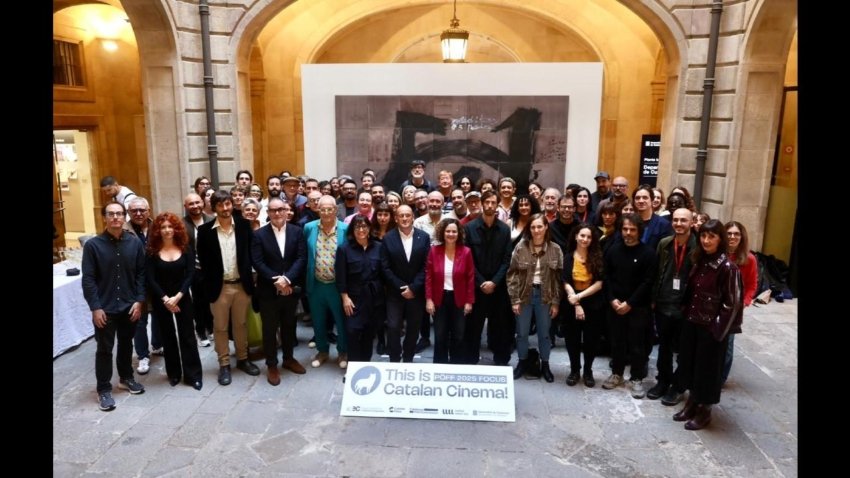
The Black Nights Festival (PÖFF) in Tallinn, Estonia, is one of Northern Europe’s most prestigious film events and the final Class A festival of 2025. This year marks its 29th edition. The festival has established itself as the leading event for the Baltic, Eastern, and Northern European audiovisual markets, with impressive figures for both audiences and industry professionals. For this edition, the festival has organized a focus on Catalan cinema running from November 7 to 23 under the motto “This is Catalan Cinema!”.
The focus is led by the Ministry of Culture of the Government of Catalonia through the Catalan Institute for Cultural Companies (ICEC), with the collaboration of the Institut Ramon Llull (IRL). This represents a major opportunity for Catalan filmmakers to broaden their horizons and connect with Baltic, Nordic, and international film professionals attending the Tallinn festival. Over 30 Catalan productions and more than 50 professionals will participate in the festival and in the market parallel to the event.
Today, the focus was presented with the participation of Sònia Hernández, Catalonia’s Minister of Culture, and the presence of many of the filmmakers who will be part of the Catalan delegation. Some of the professionals present included directors Carlos Marqués-Marcet, Judith Colell, Lluís Miñarro, Juanjo Jiménez, Carla Simón, Júlia de Paz, and Adrià Garcia, as well as producers Valérie Delpierre, Montse Triola, Alba Sotorra, and Míriam Porté.
The Tallinn focus represents the culmination of a year full of successes for Catalan cinema and cinema in the Catalan language, which this year has accumulated more than 1,300 selections at international festivals around the world and has received awards at Class A festivals such as Berlin, Cannes, Venice, Locarno, and San Sebastián, for both fiction and documentary productions. Series produced in Catalonia and in the Catalan language have also benefited from this success; in recent years we have given them significant support that has already yielded returns in the form of awards and international distribution. In addition, it includes a very interesting look at the history of our cinema with productions restored by the Filmoteca de Catalunya,” the Minister stated.
“This is Catalan Cinema!” aims to offer the festival’s international audience a carefully curated selection of works that showcase the diversity and richness of Catalan cinema. In addition, it has the objective of working toward industrial and professional development in the context of Industry@Tallinn & Baltic Event, one of the most important professional platforms for the film industry in Northern Europe. Professionals attending the market space will be able to broaden horizons and establish connections with professionals from the Baltic region and other geographic areas.
The focus acknowledges and underscores Catalonia’s commitment to a dynamic, innovative audiovisual industry connected to the world and highlights the interest of Black Nights in bringing audiences closer to new cinematographic perspectives that reflect Europe’s cultural plurality. Finally, in addition to a selection representative of the most recent Catalan cinema, the Estonian festival will also dedicate space to some of the most relevant works in the history of Catalan cinema in collaboration with the Filmoteca de Catalunya.
The opening gala of Black Nights will feature as its main protagonists the Catalan film Polvo serán, winner of the Gaudí Award for Best Film in a Non-Catalan Language, and the artist, singer, and composer Maria Arnal, author of the film’s soundtrack, who will officially open the event on November 7 in a special session in which the festival organizers will place Catalan talent at the center of attention for all attendees, nearly 2,000 professionals from around the world. Director Carlos Marqués-Marcet will accompany the Baltic première of the film, while Maria Arnal —winner of the Gaudí Award for Best Original Music for her soundtrack, and recognized for her innovative musical career and artistic sensibility—will head an evening that will combine cinema and live music.
Throughout the nearly three weeks that Black Nights lasts, up to 30 Catalan productions can be seen in the festival’s various sections. Of these productions, half have received support from Catalonia’s Ministry of Culture through one of the funding lines managed by ICEC.
The Official Selection will host the world premiere of La buena hija, by Júlia de Paz. The film, which reflects on family and intergenerational bonds through the protagonist’s story, will compete for the festival’s most important award, the Grand Prix.
The festival will also host the world premiere of Emergency Exit, the latest production by Lluís Miñarro, an ensemble film starring Marisa Paredes, Oriol Pla, and Francesc Orella, in which a series of characters travel on a bus from which they cannot alight. The film will screen in the Rebels with a Cause section, whose jury includes producer Montse Triola (Pacifiction and Liberté, among other films).
Likewise, the documentary feature Miss Jobson, directed and produced by Amanda Sans Pantling, will premiere worldwide in Doc@PÖFF, the festival’s competitive documentary section. The film’s selection confirms the strength of Catalan documentary filmmaking, which has recently won awards at San Sebastián (2024) and the Berlinale (2025) and draws from a long and fruitful tradition.
There will also be extensive Catalan representation in the In Focus section, with eight titles that showcase the most recent productions already premiered on the festival circuit.
Among the films in the focus, highlights include Isabel Coixet’s latest production, Tre ciotole, premiered worldwide at the Toronto International Film Festival; Estrany riu, by Jaume Claret Muxart, premiered at the Venice International Film Festival; Frontera, by Judith Colell, with its national premiere at SEMINCI (Valladolid International Film Festival); A la cara, by Javier Marco; Romería, by Carla Simón, premiered in the official selection of the Cannes Film Festival; Nomad Shadow, by Eimi Imanishi, premiered at the Toronto International Film Festival; Anoche conquisté Tebas, by Gabriel Azorín, premiered at the Giornate degli Autori in Venice; and Forastera, by Lucía Aleñar Iglesias, premiered at the Toronto International Film Festival, where it won the FIPRESCI Critics’ Prize.
The Best of Fest section—which, as its name indicates, programs films that have stood out at international festivals throughout the year—also features a trio of Catalan productions. These are the feature films El vol de la cigonya, by Soumaya Hidalgo Djahdou and Berta Vicente Salas, premiering at IDFA; Magalhães, by Lav Diaz; and Sirat, by Oliver Laxe, which premiered at the Cannes Film Festival—where it received the Jury Prize. Laxe’s film, furthermore, represents Spain as Best International Feature Film at the 2026 Oscar Awards.
Finally, within the Midnight Shivers section, dedicated to genre cinema, La virgen de la Tosquera, by Laura Casabé, will be presented following its world premiere at the Sundance Film Festival.
At the Just Film Youth and Children’s Film Festival, a sub-festival of PÖFF, five Catalan productions will be presented: Leo & Lou, by Carlos Solano, premiered this year at SEMINCI; the animation film El tresor de Barracuda, by Adrià Garcia, which was shown at the San Sebastián International Film Festival; L’Olívia i el terratrèmol invisible, by Irene Iborra Rizo, the first Catalan production of a stop-motion feature film, which was awarded at the latest edition of the Annecy International Animation Film Festival; Ruido, by Ingride Santos, which was screened for the first time at the Málaga Film Festival; and The Boy at the Edge of the World, by Grzegorz Wacławek and Marta Szymańska, co-produced with Poland and Turkey.
Catalan short films will feature prominently at PÖFF Shorts, the second sub-festival of Tallinn, which has selected the productions Ones, by Juanjo Giménez; Ramón Who Speaks to Ghosts, by Shervin Kermani; and Perquè avui és dissabte, by Alice Guimarães.
The Filmoteca de Catalunya plays an essential role in preserving and promoting Catalan cinematic heritage. Its participation in the Catalan Cinema Focus at Tallinn’s Black Nights is a notable example and underscores this institution’s commitment to the international projection of Catalan cinema.
In this regard, up to eight Catalan titles restored or preserved by the Filmoteca de Catalunya are part of three festival sections: Midnight Shivers, Classic Rebels, and Old Gold. This is a journey that allows rediscovery of great auteurs of our cinema, such as Bigas Luna, Pere Portabella, Agustí Villaronga, Ventura Pons, Llorenç Llobet, Armand Moreno, Francesc Rovira Beleta, and Isabel Coixet.
These are the heritage titles selected for the Black Nights Film Festival in Tallinn:
Vida en sombras, by Llorenç Llobet Gràcia (1948).
Los Tarantos, by Francesc Rovira Beleta (1963).
Maria Rosa, by Armand Moreno (1965).
Umbracle, by Pere Portabella (1972).
Ocaña, retrat intermitent, by Ventura Pons (1978).
Tras el cristal, by Agustí Villaronga (1986).
Angustia, by Bigas Luna (1987).
Cosas que nunca te dije, by Isabel Coixet (1996).
Within the framework of the Catalan Cinema Focus in Tallinn, Catalan Films—the internationalization brand for Catalan audiovisual content—is organizing four activities at Industry@Tallinn & Baltic Event, the festival’s industry area. The programme will highlight Catalonia’s strength as a pioneering audiovisual hub in Europe for international industry professionals and will include networking sessions, round tables, and meetings with industry professionals. In this way, Catalan production companies will be able to explore new opportunities for co-production, distribution, and collaboration in a privileged environment, and will have the opportunity to build creative, cultural, and business bridges with the Baltic film ecosystem.
The professional program also includes a selection of Catalan projects that are in different phases of the production process.
Seven projects in the development and post-production phase—both feature films and series—have been selected in the festival’s prestigious industry area. They will be presented to industry professionals in specialized sessions, in order to expand opportunities for financing, co-production, distribution, and festival selection.
These are the projects that will be part of the different industry areas:
Climateri (Edna Cinema, Distinto Films), by Liliana Torres.
El rei de l’aire (Materia Cinema, La Fabrica Nocturna Cinéma), by Laura Ferrés.
Aigües de foscor (Lastor Media, Cataluña Federation Studios, Federation Spain, New Media), by Víctor Garcia.
Pubertat (Distinto Films, Corte y Confección de Películas, Uri Films, AT-Prod), by Leticia Dolera.
Les convulsions (Auca Films, Cinètica Produccions, Timber Films, IMY Prod), by David Gutiérrez Camps.
Salen las lobas (Alba Sotorra, Paloma Productions, Novak Films), by Clàudia Estrada.
Tanit (Atiende Films, Dacsa Produccions), by Pep Garrido.
For several years now, Catalan cinema has been making a strong impression on Europe. Fiction, animation, and documentary audiovisual productions play a very significant role in festivals everywhere, receive international awards, and are released on screens around the world. The recognition from critics and international audiences is unanimous, and the prestige of Catalan professionals is a reflection of a very powerful industry, with undeniable talent and enormously high-quality training.
In 2024, Catalonia’s Ministry of Culture devoted more than 60 million euros to the audiovisual sector, a record figure. Audiovisual production continues to be one of the Government’s priorities for this legislature and promoting it as a strategic sector is a priority. The funding lines of Catalonia’s Ministry of Culture—managed through ICEC—cover the entire value chain of audiovisual production, with allocations intended, for example, for development and co-production. The Institut Ramon Llull, for its part, promotes the internationalization of audiovisual production through its competitive funding lines and collaboration with international film festivals.
This support has helped make visible and consolidate some of the values for which Catalan audiovisual production stands out: the talent of professionals, the existence of internationally recognized training centres, the work and commitment of a powerful audiovisual industry—which draws from a long tradition and generates an enormous variety of productions—and the wealth of a very extensive number of festivals that place the country on the international map.