


We open the exhibition ‘Cures: a collapsed system’
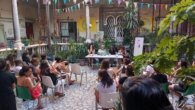
Next Friday March 6 at Bloc4BCN the exhibition opens ‘Care: a collapsed system’ driven by Circle of Feminist Economies of Coòpolis and the illustrator Sarah Jansen in collaboration with other entities of the third sector and the Social and Solidarity Economy, as is the case of More than Cures. A creative bet that, through a visual narrative of denunciation, politics and dystopia, emphasizes the dignity of care as an essential task for the functioning of society. The opening will be on Friday, March 6 at 6 p.m. at Bloc4BCN.
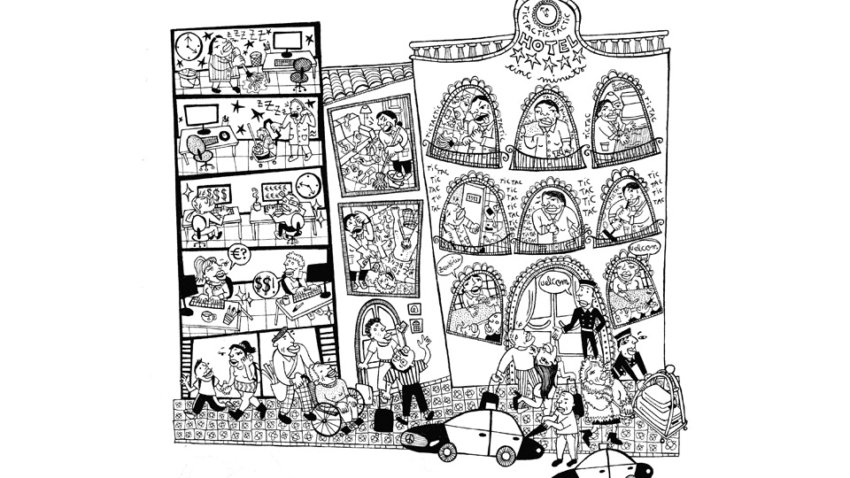
The exhibition is structured around two large complementary illustrations. On the one hand, the current representation of the care system through a pyramidal society where carers and workers are undoubtedly the most harmed. And, on the other hand, one dystopian representation of the world facing an alleged health care strike. “The intention has been to ask ourselves what care is like today and what would happen if whoever supports the system decides to stop doing it”, shares Jansen. From this logic, the first representation takes us to naturalized scenes such as the case of sexual assaults on caregivers of dependent people in their homes, a structural and invisible violence that affects, to a large extent, migrant women The second representation, on the other hand, shows a society in saturation and immersed in the chaos of paused care: luxury homes full of dirt, overflowing hospital corridors, empty refrigerators in elderly people’s apartments, etc. “The crux of the matter here is to ask ourselves how far we need to reach this dystopian scenario to talk about collapse in the current care system”raise fromAt least Feminist Cooperativeone of the entities of the Cercle d’Economies Feministes de Coòpolis.
In the framework of March 8, and with the aim of putting the focus on a structural change of the social model, a profound transformation the way society organizes, undertakes and values care tasks. Faced with demographic, social and labor changes, the initiative defends that the current model is unsustainable and unequaland proposes to move towards a fairer, collective and co-responsible system. The illustrative proposal is based on a story about four main axes. The first is the defamiliarization of carein a context marked by ever smaller families and a highly liberalized labor market, which makes it difficult for responsibility to fall exclusively on the family sphere. The second axis bets on the decommoditizationdemanding more public provision of care services and a redistribution of public resources that allows these responsibilities to be assumed as a collective right, and not as a consumer good dependent on each person’s income. A third key element is the decolonization of care, with the aim of avoiding a system sustained by the precarious work of migrant women. Finally, the emphasis is placed on the denaturation of care as a female task, questioning the gender roles that make this work invisible and place women as the main ones responsible, both in the domestic and professional spheres. “The exhibition comes at a key moment of building a network and promoting other demands, as is the case with the strike for the rising cost of living that wants to materialize in the autumn”, they explain from the circle. Doing it in the context of International Women’s Day is no coincidence either, since it has long been pointed out the importance of having the feminist fabric in a struggle that is not alien to them. “Mothers, daughters, wives and grandmothers are the main caregivers in most cases, and they dedicate their time, work and affection to caring for others”, they remember from Dignified Care. And it is that the current social organization of care generates processes like the one mentioned social gender gapwhich, among other impacts, means that in Catalonia men earn 23% more than women because they have more difficulty reconciling family life with work.
The photographic exhibition will be used to strengthen this gap ‘We take care, and who takes care of us?’ de Més que Cures, which has been making its way through different spaces in the city of Barcelona for some time now. Seven women caregivers who have transformed their stories into powerful images, through theater and collective creation, speaking from the organized force and remembering all those violences that have so often been silenced: endless days, constant availability, invisibility, etc. A project that invites care workers and family carers to participate in a creative and collective space to reflect, share emotions and give visibility to the value of their work through the participatory photography. A show driven by theMore Than Cures Associationwith The Revealed, @teatrearnautinerantand the support of Oxfam Intermón and Barcelona City Council.
It is hoped that this joint bet will remember that care is a human right and a common good and that to make it possible with dignity, it is necessary to collectivize it and dignify it through citizen participation and co-creation spaces. “It is urgent to combat sexist, racist and classist stereotypes around care, because these imaginaries reinforce precarious employment and the devaluation of essential work”, they conclude.