


Ramon Llovet, between reality and lyricism / Exhibitions / Visit us / Home
Ramon Llovet i Miserol was born in 1917 in the Poble Sec neighborhood of Barcelona. From a young age he felt inclinations towards painting and drawing, looking up to Antoni Clavé, who was an unavoidable reference during the first years of his training. He was almost self-taught, despite attending some classes at the Llotja and the Ateneu Obrer.
With the outbreak of the civil war, he is forced to fight on the Andalusian front, although in a fleeting way. Affected by health issues, he returns to Barcelona. The drawings of the front, loaded with fantasy and a certain naivete, are a witness to this stay, which already reveal his anti-war spirit and a spiritual legacy that will be accentuated over the years.
Llovet’s artistic language will be closely linked to his personal growth. Once the war was over, he returned to painting and did so following the artistic tradition of the country, working on a painting focused on the most humble landscapes of the city, especially the Somorrostro neighborhood and the barracks of Montjuïc. It is a skillful painting, which demonstrates the painter’s intuition, but which is not yet his own.
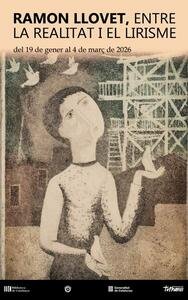
He will not find his way until well into the fifties when, upon learning about Solana’s work, his painting will take a Copernican turn. Their lonely landscapes begin to welcome people, they become humanized, and become a symbol and mirror of a society torn apart by war, immersed in loneliness and misery. Llovet portrays a disturbing world, loaded with symbolism, even cryptic. These nightmarish scenarios deepen towards an inner world full of questions, almost tortured. This is probably his most interesting stage.
This is evidenced by an evolution towards an increasingly dark color palette and an increasingly pronounced use of textures. Influenced by informalist currents and again by Antoni Clavé, he experiments with materials, creating new artistic techniques devised by himself. In this sense, the use of plasterboards for stamping engravings is particularly interesting.
Llovet gives vent to the vital anguish that characterizes his work during the first decades of his career and finally reaches a state of personal fulfillment from the sixties onwards. The influence of Eastern thought, of Krishnamurti, theosophy and, above all, the pacifist currents embodied by Lanza del Vasto left a strong mark on his work. The darkness of his paintings changes towards luminous and lyrical tones, increasingly ethereal, and compositions marked by an almost esoteric and mystical symbolism. This serene and vitalistic language will characterize the last years of his career until his death in 1987.
Bernat Puigdollers, art historian